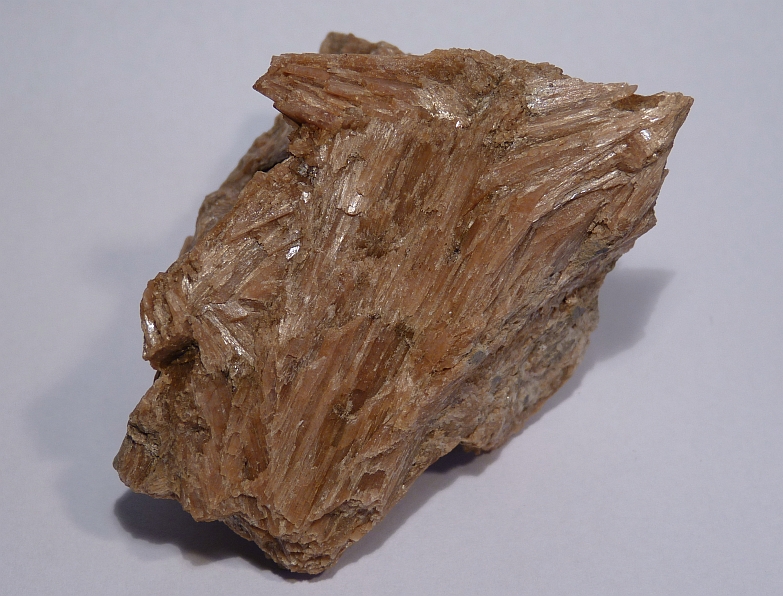
Bustamite (Specimen size 7 x 5 cm) Locality: Meldon Quarry (British Rail Quarry; British Railways Quarry; B. R. Quarry), Okehampton area (Northern Dartmoor), De — Photo: Leon Hupperichs · CC BY-SA 3.0
Bustamite
A calcium-manganese chain silicate of the wollastonite group — the high-temperature polymorph, with johannsenite its low-temperature counterpart.
Intro adapted from Wikipedia (CC BY-SA).
Bustamite is an IMA-recognized mineral species in the silicate class, with the chemical formula Mn₂Ca₂MnCa(Si₃O₉)₂.
It crystallizes in the triclinic crystal system (space group F-1). It is a member of the Wollastonite structural group.
Key properties: Mohs hardness 5.5–6.5; specific gravity 3.32–3.43; typically pink or brown or gray; white streak; Vitreous luster; refractive index 1.676; optically biaxial.
IMA symbol Bst, grandfathered status — known before the IMA’s founding, named in 1826.
Found in manganese ores formed by metamorphism of manganese-bearing sediments with attendant metasomatism; typically in association with skarns.
It is found associated with Rhodonite, tephroite, calcite, glaucochroite, johannsenite, wollastonite, diopside, grossular.
In honor of General Anastasio Bustamente (1780–1853), of Mexico.
Collections: Collector Favorites.