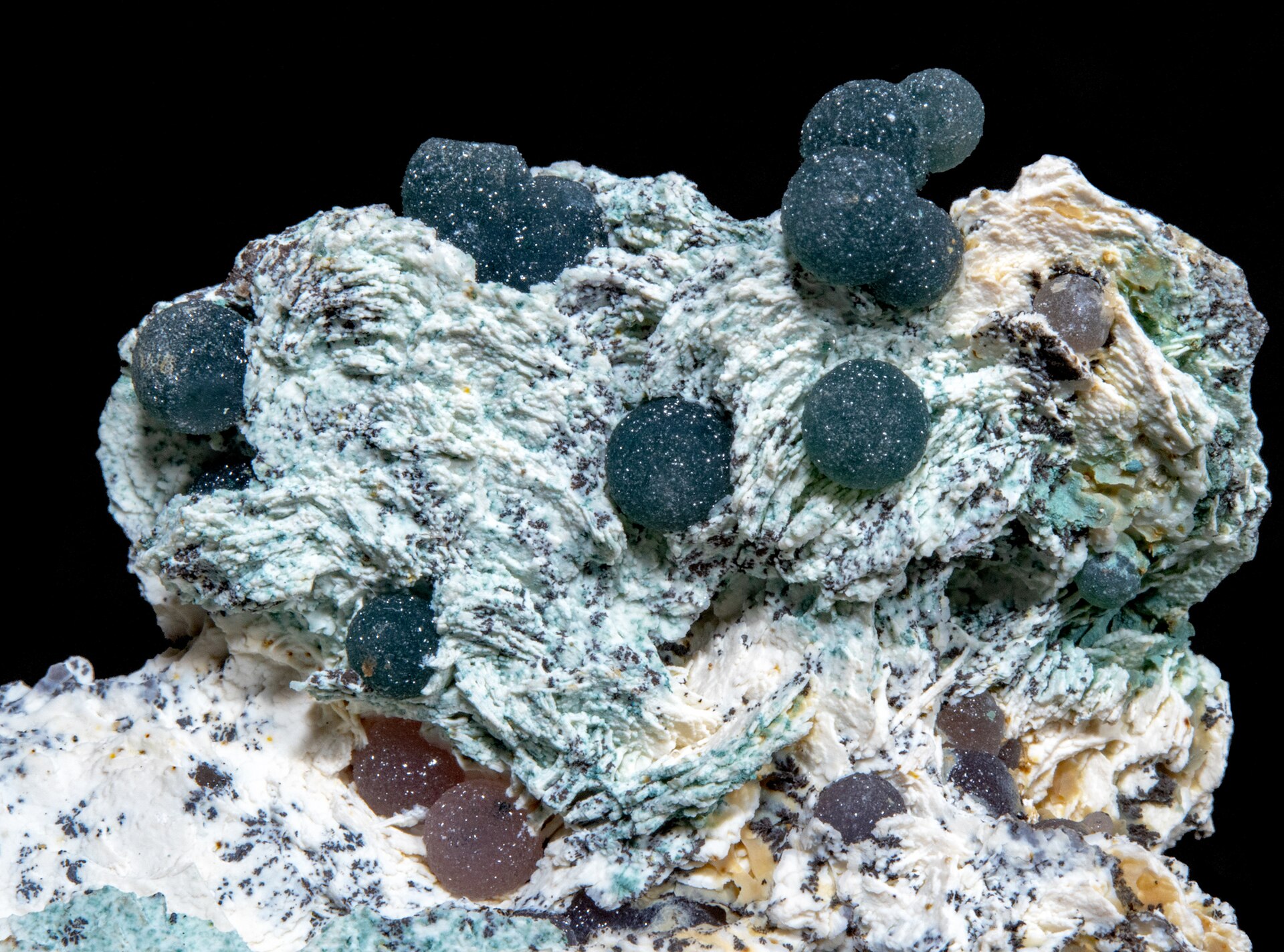
quartz var. chalcedony, celadonite : Mamuju area (Mamudju ; Manakara), Sulawesi Barat Province (West Sulawesi Province), Sulawesi (Celebes), Indonesia — Photo: Géry PARENT · CC BY-SA 4.0
Celadonite
Celadonite is a mica group mineral, a phyllosilicate of potassium, iron in both oxidation states, aluminium and hydroxide with formula K(MgFe3+◻)(Si4O10)(OH)2. It crystallizes in the monoclinic system and usually forms massive aggregates of prismatic crystallites or, more commonly, in dull clay masses. It is soft with a Mohs hardness of 2 and a specific gravity of 3. It forms vesicle fillings and linings in altered basaltic lavas.
Intro adapted from Wikipedia (CC BY-SA).
Celadonite is an IMA-recognized mineral species in the silicate class, with the chemical formula KMgFe³⁺Si₄O₁₀(OH)₂.
It crystallizes in the monoclinic crystal system (space group C2/m). It is a member of the Mica, Clay structural group.
Key properties: Mohs hardness 2; specific gravity 2.95–3.05; typically green; white streak; Dull luster; optically biaxial.
IMA symbol Cel, IMA status: approved, named in 1847.
Replaces primary ferromagnesian silicate minerals in altered intermediate to mafic volcanic rocks, developed under low-grade zeolite facies metamorphism; as amygdule fillings in basalts or andesites.
It is found associated with Montmorillonite, clinoptilolite, heulandite, laumontite, prehnite, chlorite, quartz, calcite.
The name comes from the French celadon, for sea green, its color.
Collections: Collector Favorites.