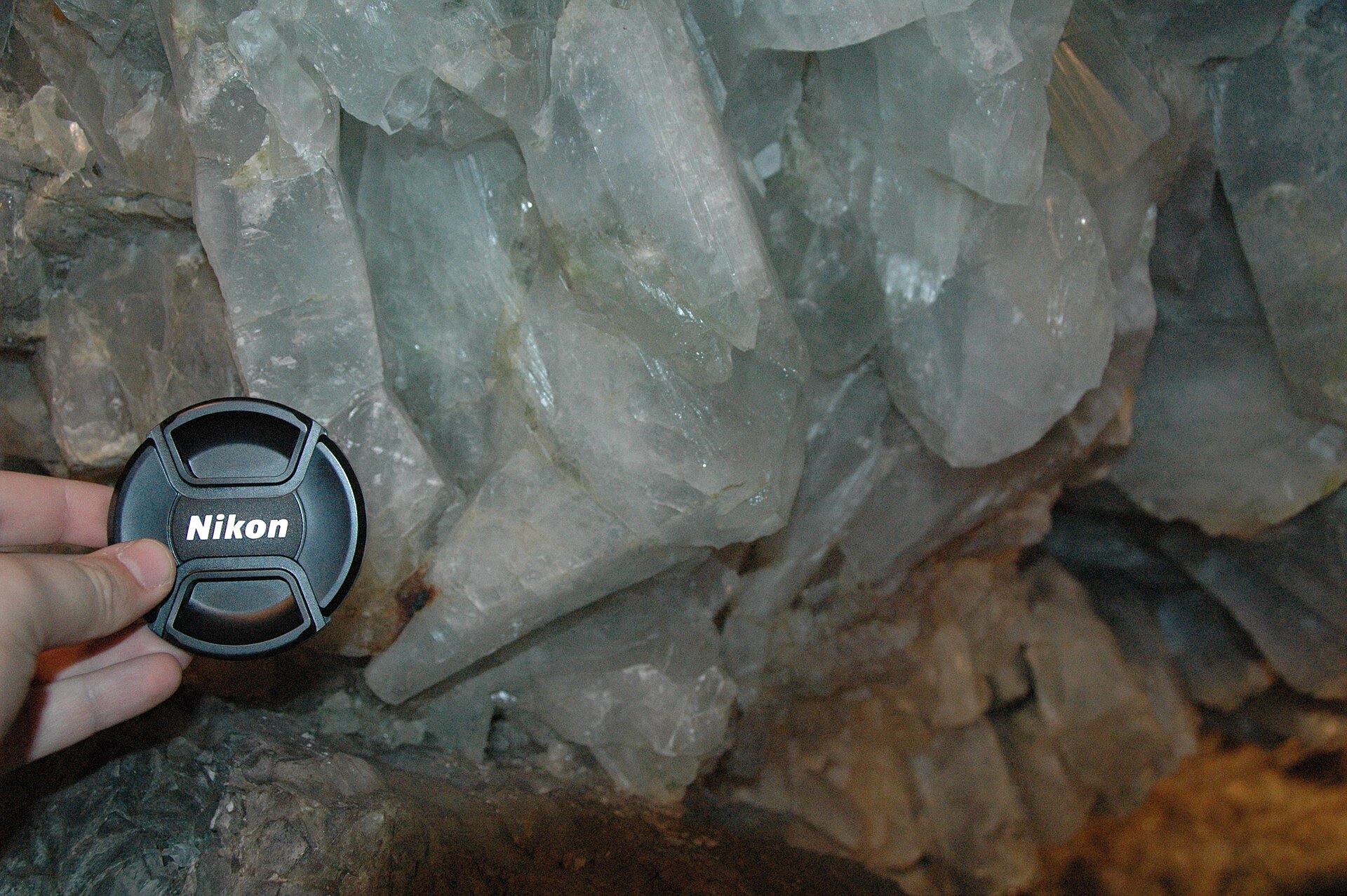
Crystal Cave is located in western South Bass Island, western Lake Erie Basin, far-northern Ohio, USA. It is a small cave developed in the Put-in-Bay Dolomite ( — Photo: James St. John · CC BY 2.0
Celestine
Also known as: Celestite.
Strontium sulfate — the principal ore of strontium — named for the delicate sky-blue color some crystals show.
Intro adapted from Wikipedia (CC BY-SA).
Celestine is an IMA-recognized mineral species in the sulfate class, with the chemical formula Sr(SO₄).
It crystallizes in the orthorhombic crystal system (space group Pnma). It is a member of the Baryte structural group.
Key properties: Mohs hardness 3–3.5; specific gravity 3.97; typically blue or colorless or white or yellow or pink or orange; white streak; Vitreous, pearly on cleavages luster; optically biaxial.
IMA symbol Clt, IMA status: approved, named in 1778.
Of primary sedimentary origin, diagenetic, or typically as fissure and cavity fillings (including caves) precipitated by migrating strontium-bearing ground water or basinal brines in carbonate rocks, concretions and nodules.
It is found associated with Gypsum, anhydrite, sulfur (bedded evaporites); strontianite, calcite, dolomite, anhydrite, gypsum, fluorite (cavities in carbonate rocks); analcime, natrolite.
The name comes from the Latin for celestial, in allusion to the typical bluish color.
Collections: Collector Favorites.