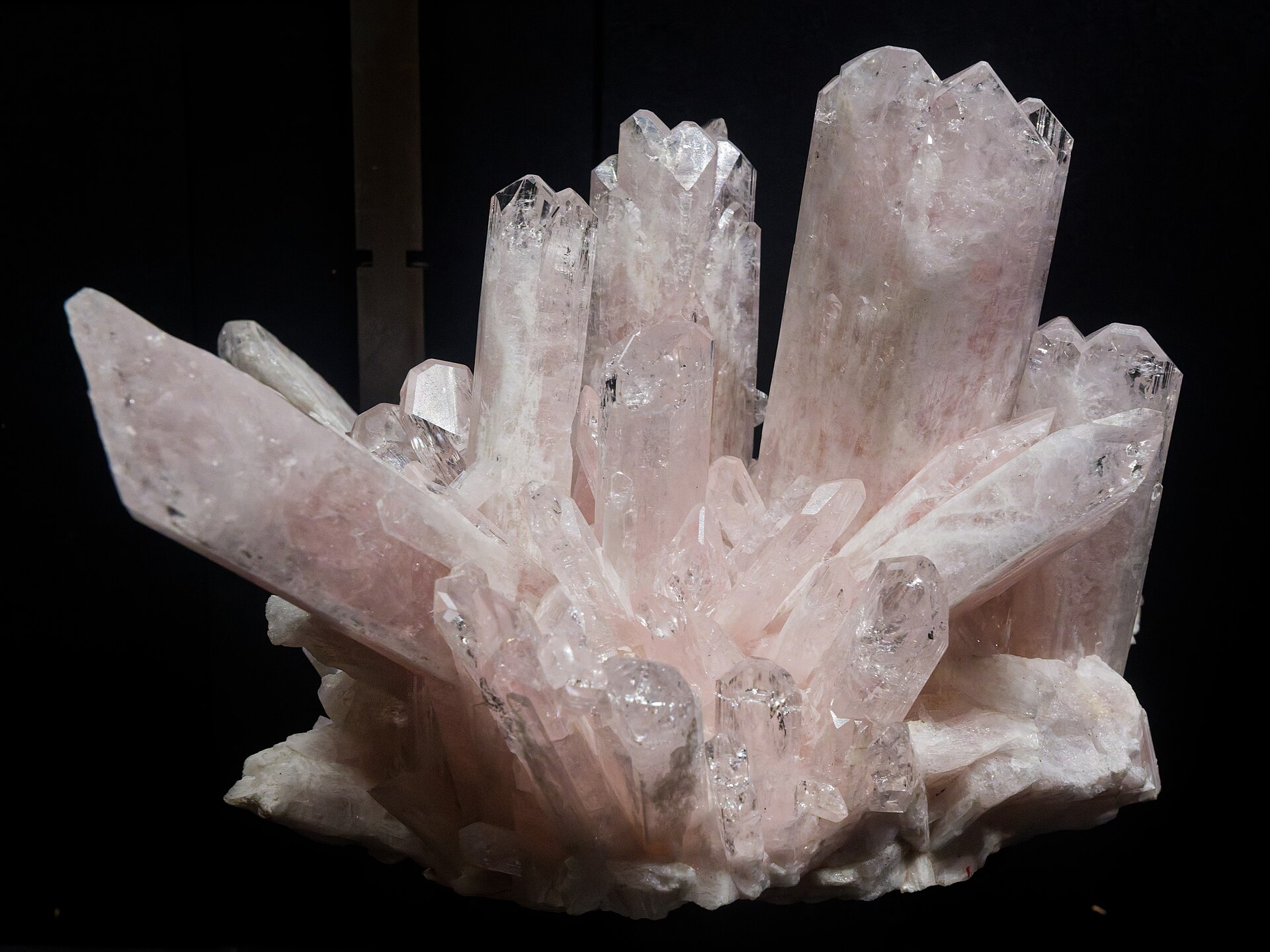
Danburite from a dozen groups of crystals extracted with explosives from the mine of Charcas, San Luis Potosí, Mexico. Sorbonne University mineral collection. — Photo: Marie-Lan Taÿ Pamart · CC BY 4.0
Danburite
A calcium borosilicate resembling topaz — hard (Mohs 7–7.5), transparent, and occasionally faceted as a gem.
Intro adapted from Wikipedia (CC BY-SA).
Danburite is an IMA-recognized mineral species in the silicate class, with the chemical formula CaB₂Si₂O₈.
It crystallizes in the orthorhombic crystal system (space group Pbnm). It is a member of the Danburite structural group.
Key properties: Mohs hardness 7–7.5; specific gravity 2.93–3.02; typically colorless or white or yellow or pink or brown; White streak; Vitreous to greasy luster; refractive index 1.633; optically biaxial.
IMA symbol Dbu, grandfathered status — known before the IMA’s founding, named in 1839.
Found in granite and metamorphosed carbonate rocks in association with hydrothermal activity; in evaporites.
It is found associated with Titanite, axinite, tourmaline, mica, quartz, grossular, albite, fluorite, apophyllite, stilbite, datolite, bakerite, dolomite, calcite, anhydrite, gypsum.
The name is derived from the locality at Danbury, Connecticut, USA.
Collections: Gemstones, Collector Favorites.