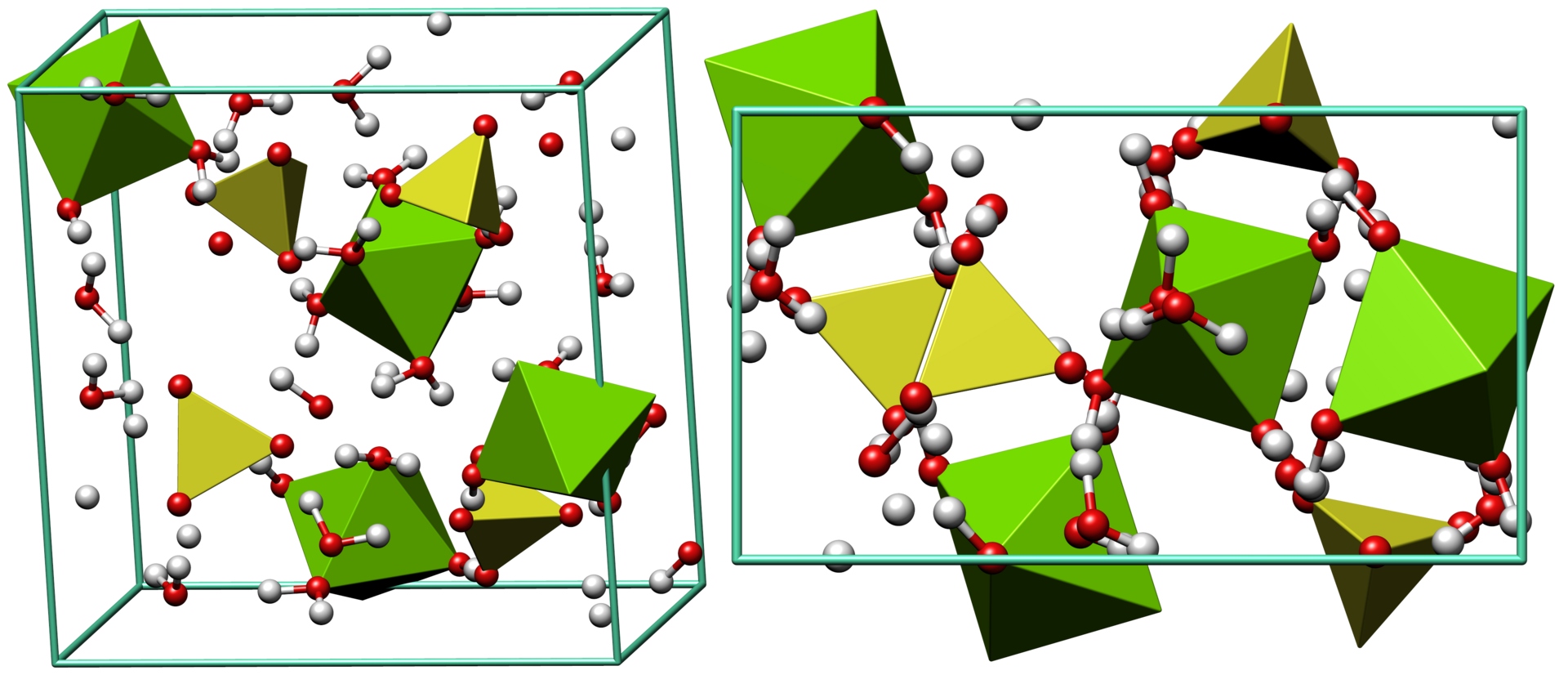
Crystal structure of epsomite - MgSO4·7H2O. Baur W H — Photo: MarinaVladivostok · CC0
Epsomite
Also known as: Epsom salt.
Hydrated magnesium sulfate — the mineral form of Epsom salt, crystallizing as crusts on cave and mine walls.
Intro adapted from Wikipedia (CC BY-SA).
Epsomite is an IMA-recognized mineral species in the sulfate class, with the chemical formula Mg(SO₄)·7H₂O.
It crystallizes in the orthorhombic crystal system (space group P2_12_12_1). It is a member of the Epsomite structural group.
Key properties: Mohs hardness 2–2.5; specific gravity 1.677; typically white or colorless; white streak; Vitreous, silky in fibrous aggregates luster; refractive index 1.45; optically biaxial.
IMA symbol Esm, grandfathered status — known before the IMA’s founding, named in 1806.
Occurs as efflorescences on the walls of mines, caves, and outcrops of sulfide-bearing magnesian rocks; a product of evaporation at mineral springs and saline lakes; a hydration product of kieserite and langbeinite.
It is found associated with Melanterite, gypsum, halotrichite, pickeringite, alunogen, rozenite (efflorescences); mirabilite (lacustrine evaporites).
The name refers to the occurrence at Epsom, England.
Collections: Everyday Minerals.