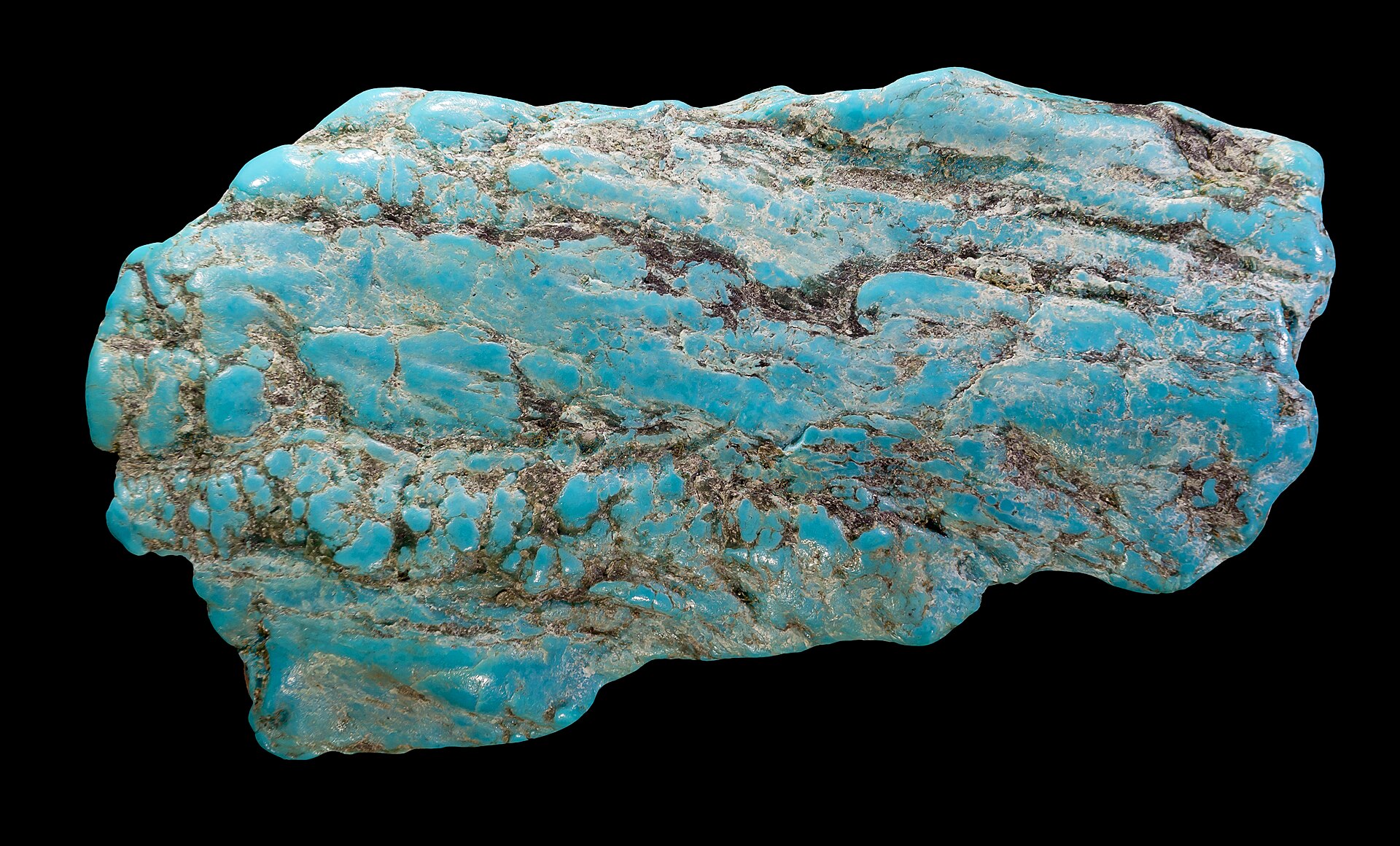
Howlite artificially colored in blue, and sold under the name turquenite. Locality: Tick Canyon, Lang, Los Angeles Co., California, USA. Size : 7.27 x 3.9 x — Photo: Didier Descouens · CC BY-SA 4.0
Howlite
Also known as: Magnesite imitation (when dyed).
A white calcium borosilicate of evaporite deposits — famous as an inexpensive turquoise imitation when dyed.
Intro adapted from Wikipedia (CC BY-SA).
Howlite is an IMA-recognized mineral species in the silicate class, with the chemical formula Ca₂SiB₅O₉(OH)₅.
It crystallizes in the monoclinic crystal system (space group P2_1/c).
Key properties: Mohs hardness 3.5; specific gravity 2.53–2.59; typically white or gray; white streak; Subvitreous, glimmering luster; refractive index 1.593; optically biaxial.
IMA symbol How, grandfathered status — known before the IMA’s founding, named in 1868.
Found in borate deposits.
It is found associated with Colemanite, ulexite, bakerite.
The name refers to Henry How (1828–1879), Canadian chemist, geologist, and mineralogist, University of King's College, Windsor, Nova Scotia, Canada, who first described the species.
Collections: Gemstones, Everyday Minerals.