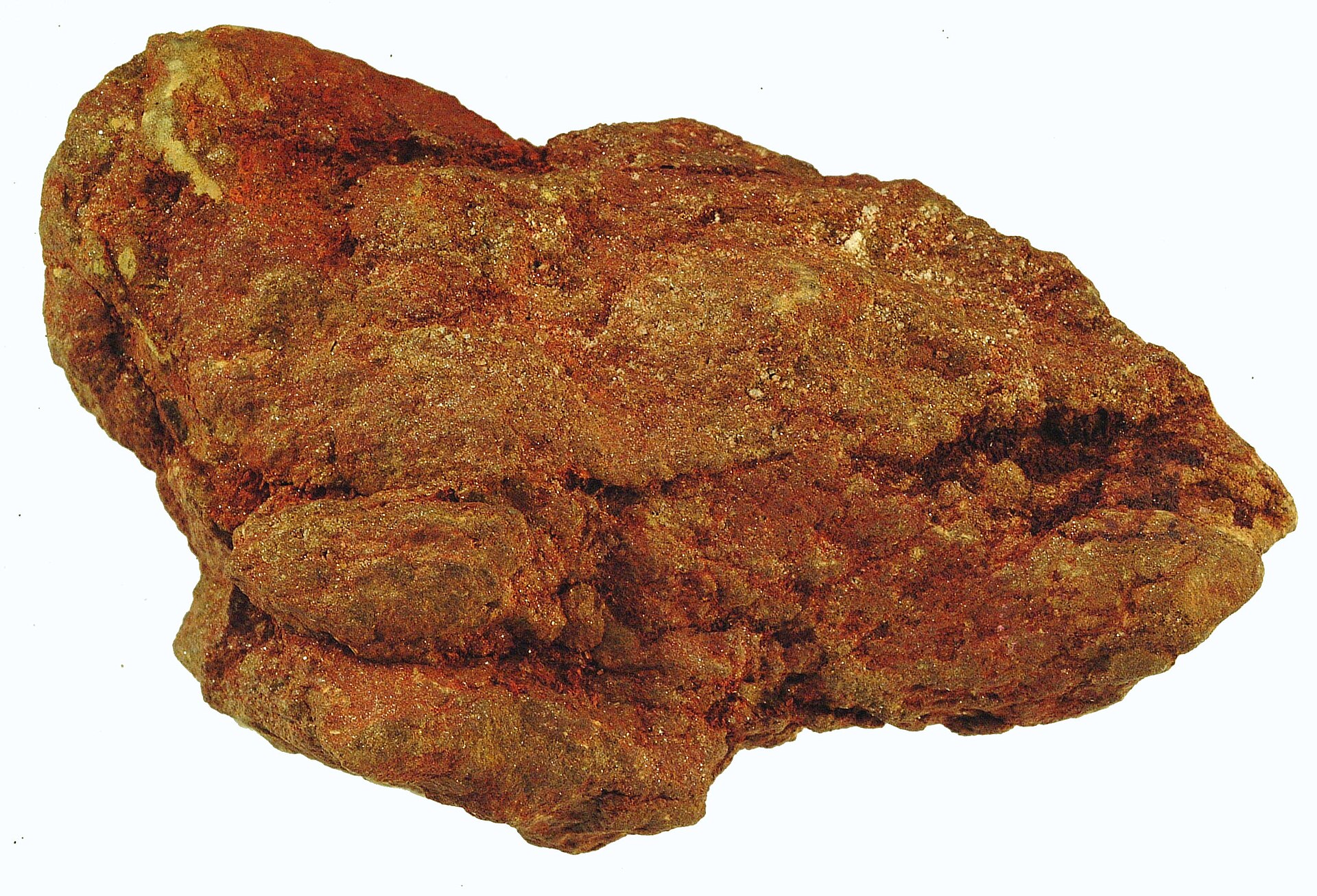
Jarosite, an uncommon mineral, forms by weathering in arid regions. It has composition KFe3(SO4)2(OH)6. It is closely related to the mineral natrojarosite, whic — Photo: Darla Sondrol · CC0
Jarosite
A yellow-brown potassium-iron sulfate formed when pyrite oxidizes — a hallmark of gossans and, famously, of Mars's surface.
Intro adapted from Wikipedia (CC BY-SA).
Jarosite is an IMA-recognized mineral species in the sulfate class, with the chemical formula KFe³⁺₃(SO₄)₂(OH)₆.
It crystallizes in the hexagonal crystal system (space group R-3m). It is a member of the Alunite-Alunite structural group.
Key properties: Mohs hardness 2.5–3.5; specific gravity 2.91–3.26; typically brown or yellow or orange; Pale yellow streak; Subadamantine to vitreous, resinous on fractures luster; refractive index 1.767; optically uniaxial.
IMA symbol Jrs, IMA status: approved, named in 1852.
Found as a secondary mineral in oxidized portions of sulfide-bearing rocks, typically altering from pyrite; less common as a low-temperature, primary hydrothermal mineral, including as deposits around hot springs.
It is found associated with Alunite, pyrite.
The name refers to the Barranco del Jaroso, Spain, from where the first scientifically studied specimens were obtained.
Collections: Collector Favorites.