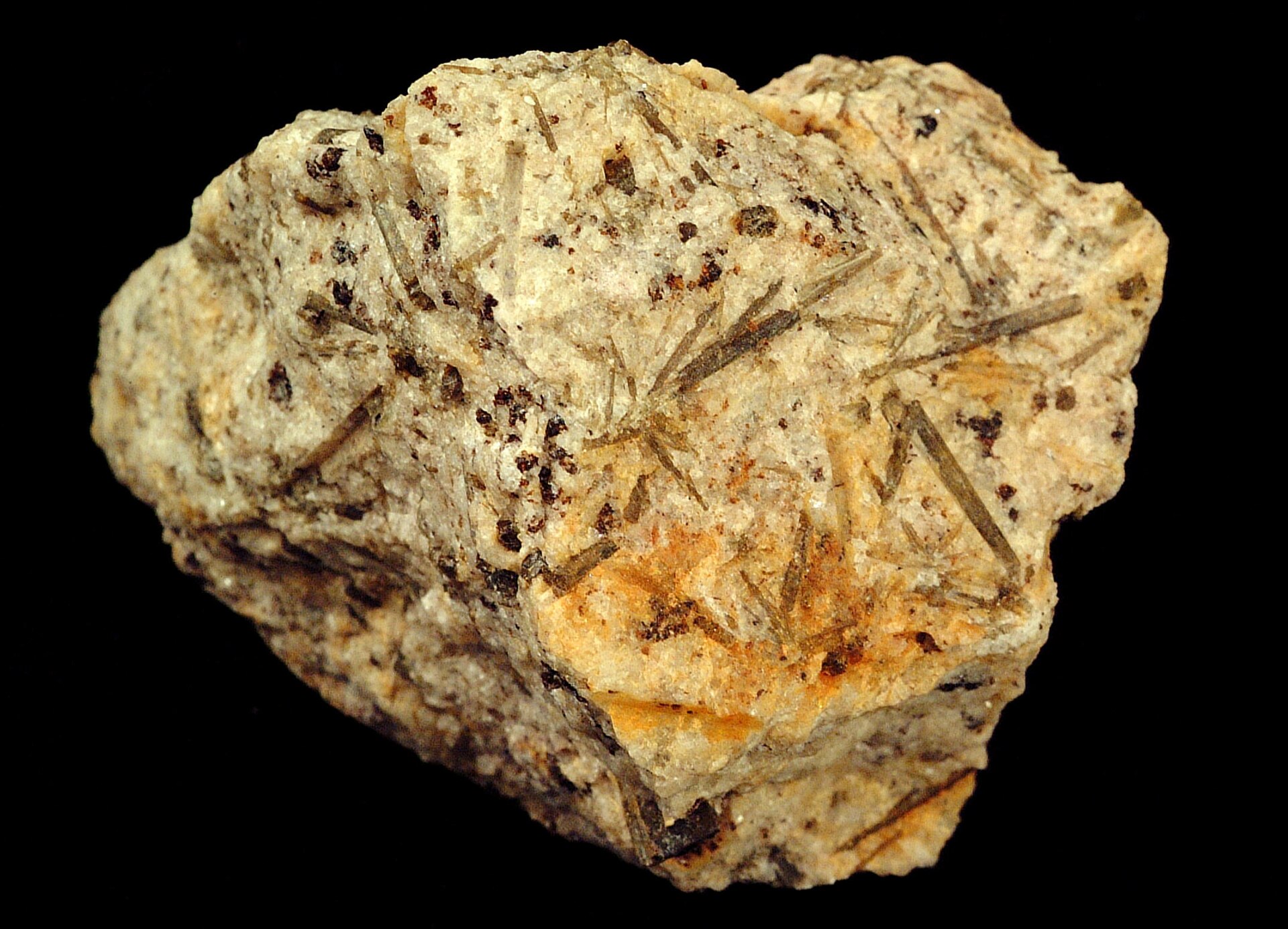
The bladed mineral is kornerupine, Mg(Mg,Fe,Al)9(Si,Al,B)5O21(O,OH,F). It is in a sea of quartz that also contains small equant dark red garnets. Kornerupine is — Photo: Nessa Eull · CC0
Kornerupine
A rare magnesium-aluminium borosilicate forming tourmaline-like prisms — a collector's gem with strong pleochroism.
Intro adapted from Wikipedia (CC BY-SA).
Kornerupine is an IMA-recognized mineral species in the silicate class, with the chemical formula (Mg,Fe²⁺,Al, )₁₀(Si,Al,B)₅O₂₁(OH,F)₂.
It crystallizes in the orthorhombic crystal system (space group Cmcm). It is a member of the Kornerupine structural group.
Key properties: Mohs hardness 6.5–7; specific gravity 3.29–3.35; typically green or brown or blue; white streak; Vitreous luster; refractive index 1.674; optically biaxial.
IMA symbol Krn, grandfathered status — known before the IMA’s founding, named in 1884.
Found in boron-rich volcanic and sedimentary rocks subjected to amphibolite to granulite facies metamorphism; in metamorphosed anorthosite complexes.
It is found associated with Sapphirine, cordierite, spinel, corundum, tourmaline, grandidierite, dumortierite, kyanite, sillimanite, andalusite, biotite, phlogopite, magnetite, ilmenite.
The name refers to the Danish geologist, Andreas Nikolaus Kornerup (1857-1883).
Collections: Gemstones, Rare & Remarkable.