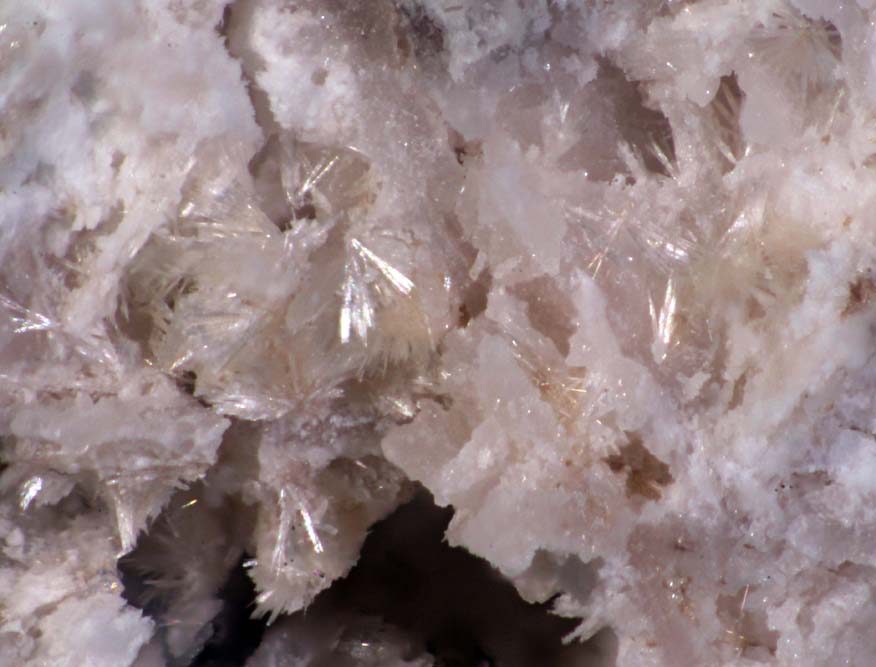
Greyish-white crystals of the very rare mineral laplandite-(Ce) from the type locality (Yubileinaya Pegmatite, Lovozero Massif, Kola, Russian Federation) and only one of the two known localities worldwide. Associated minerals are zorite, terskite and eudialyte. Ex. F.Bauer collection. — Photo: David Hospital · CC BY-SA 4.0
Laplandite-(Ce)
Laplandite has a general formula of Na4CeTiPO4Si7O18•5H2O, and is found primarily in igneous rocks. This silicate mineral has been found as inclusions in pegmatites, primarily in the Kola Peninsula in Lappland, where the mineral's name gets its origin. Laplandite is orthorhombic, which states that crystallographically, it contains three axes of unequal lengths that all intersect at 90 degrees, perpendicular to one another. The shape of the crystal is bipyramidal, and is similar in structure to olivine or aragonite.
Intro adapted from Wikipedia (CC BY-SA).
Laplandite-(Ce) is an IMA-recognized mineral species in the silicate class, with the chemical formula Na₄CeTiPSi₇O₂₂·5H₂O.
It crystallizes in the orthorhombic crystal system (space group Pmmm).
Key properties: Mohs hardness 2–3; specific gravity 2.83; Vitreous to greasy luster; optically biaxial.
IMA symbol Lpl-Ce, IMA status: approved, named in 1974.
Found in the natrolite zone of a pegmatite in a differentiated alkalic massif.
It is found associated with Belovite, nordite, s¶erandite, thermonatrite, steenstrupine, leucosphenite, sphalerite, ilma jokite, raite, zorite.
The name refers to Lappland (Lapland), the region in which the Kola Peninsula lies.