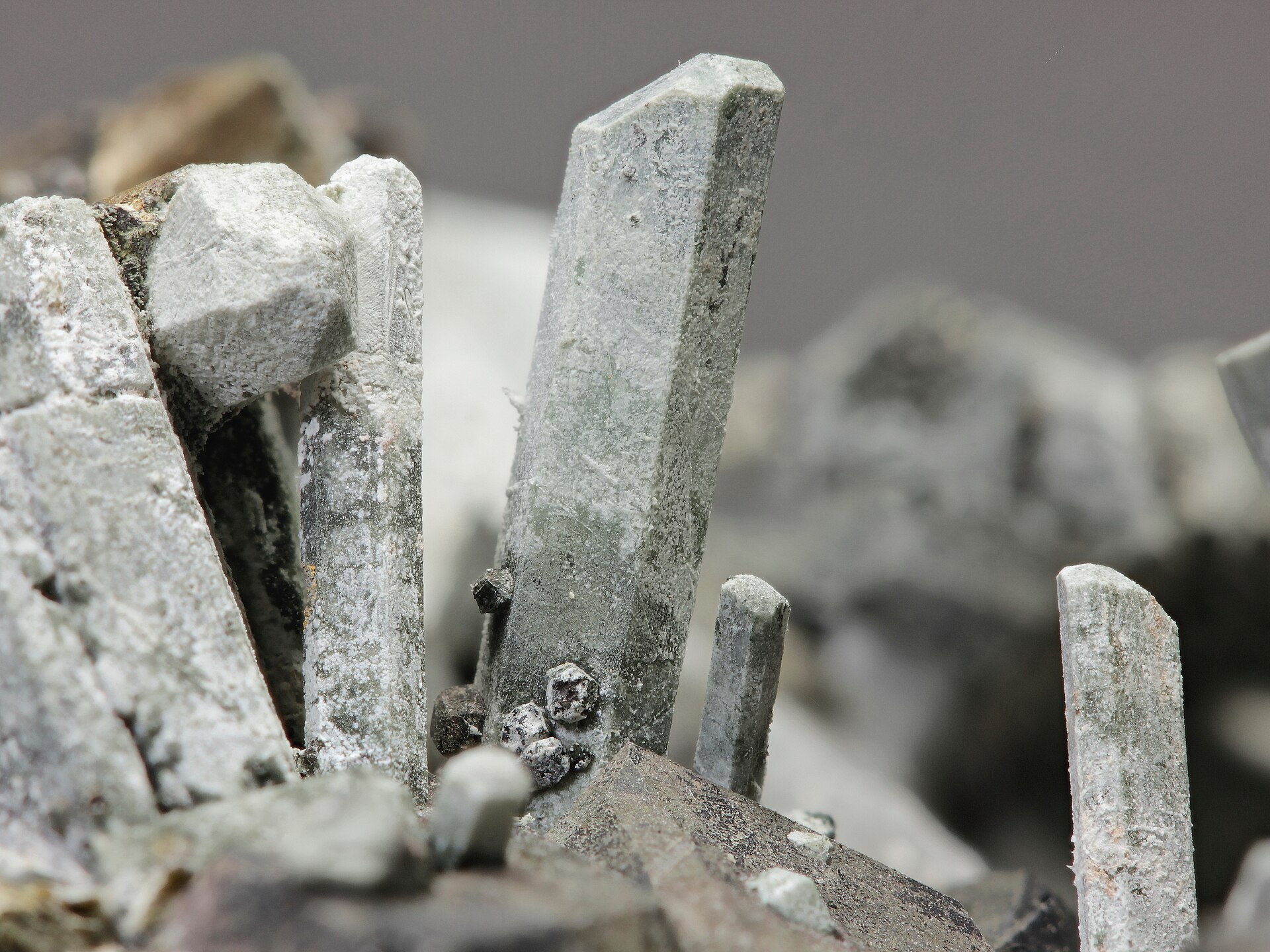
Nepheline Dimensions: 55 mm x 50 mm x 35 mm; Field of view: 20 mm; Largest crystal: 15 mm Locality: Jebel Bou-Agrao, Amersid, Aït Oufella Caïdat, Midelt Cercle, — Photo: Jyrki Autio · Public domain
Nepheline
Also known as: Nephelite.
A feldspathoid of silica-poor igneous rocks — its name comes from 'cloud', as it turns cloudy in acid.
Intro adapted from Wikipedia (CC BY-SA).
Nepheline is an IMA-recognized mineral species in the silicate class, with the chemical formula Na₃K(Al₄Si₄O₁₆).
It crystallizes in the hexagonal crystal system (space group P6_3). It is a member of the Tridymite-Nepheline, Tridymite-Nepheline structural group.
Key properties: Mohs hardness 5.5–6; specific gravity 2.55–2.66; typically white or colorless or gray; white streak; Vitreous to greasy luster; refractive index 1.536; optically uniaxial.
IMA symbol Nph, IMA status: approved, named in 1801.
Characteristic of alkalic rocks as nepheline syenites and gneisses, alkalic gabbros; in sodium-rich hypabyssal rocks, tuffs and lavas, and pegmatites; as a product of sodium metasomatism.
It is found associated with Potassic feldspar, plagioclase, sodic pyroxenes, sodic amphiboles, leucite, olivine, augite, diopside.
Its name comes from the Greek for cloud, as it becomes cloudy when treated with strong acid.
Collections: Everyday Minerals, Collector Favorites.