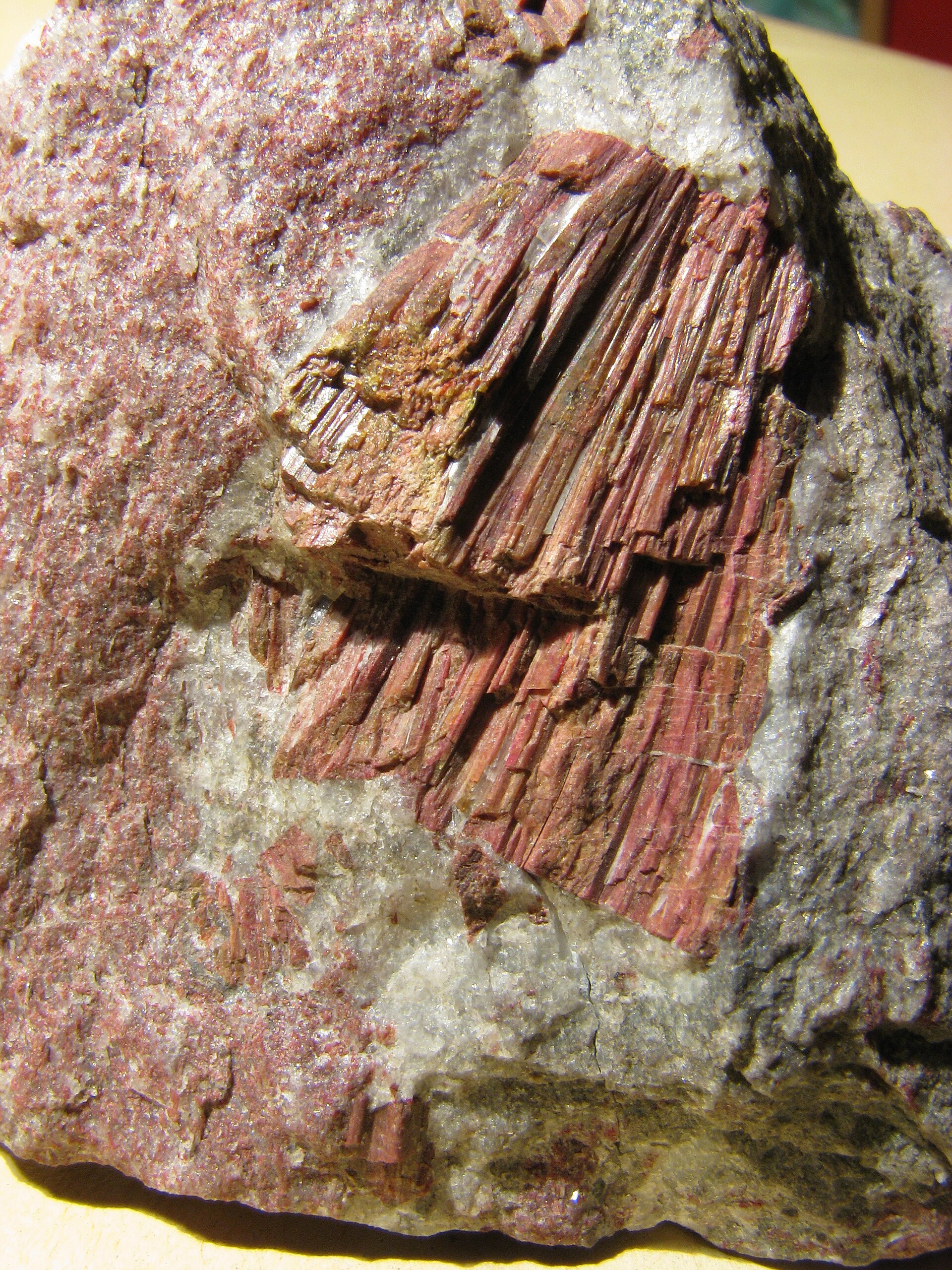
Piemontite - Locality: St. Marcel, Aosta, Italy — Photo: Aangelo · CC BY-SA 3.0
Piemontite
The red-to-black manganese member of the epidote group — the 'piedmontite' of metamorphic rocks.
Intro adapted from Wikipedia (CC BY-SA).
Piemontite is an IMA-recognized mineral species in the silicate class, with the chemical formula Ca₂(Al₂Mn³⁺)[Si₂O₇][SiO₄]O(OH).
It crystallizes in the monoclinic crystal system (space group P2_1/m). It is a member of the Epidote structural group.
Key properties: Mohs hardness 6; specific gravity 3.46–3.54; typically red or brown or black or yellow; Reddish streak; Vitreous luster; refractive index 1.764; optically biaxial.
IMA symbol Pmt, IMA status: approved, named in 1853.
Found in regionally metamorphosed rocks of the greenschist to amphibolite facies; in metasomatized manganese deposits; in low-temperature hydrothermal veins in altered rhyolites, andesites, and diorites.
It is found associated with Epidote, tremolite, glaucophane, orthoclase, quartz, calcite.
The name commemorates the Piemonte (Piedmont) region in northwestern Italy.
Collections: Collector Favorites.