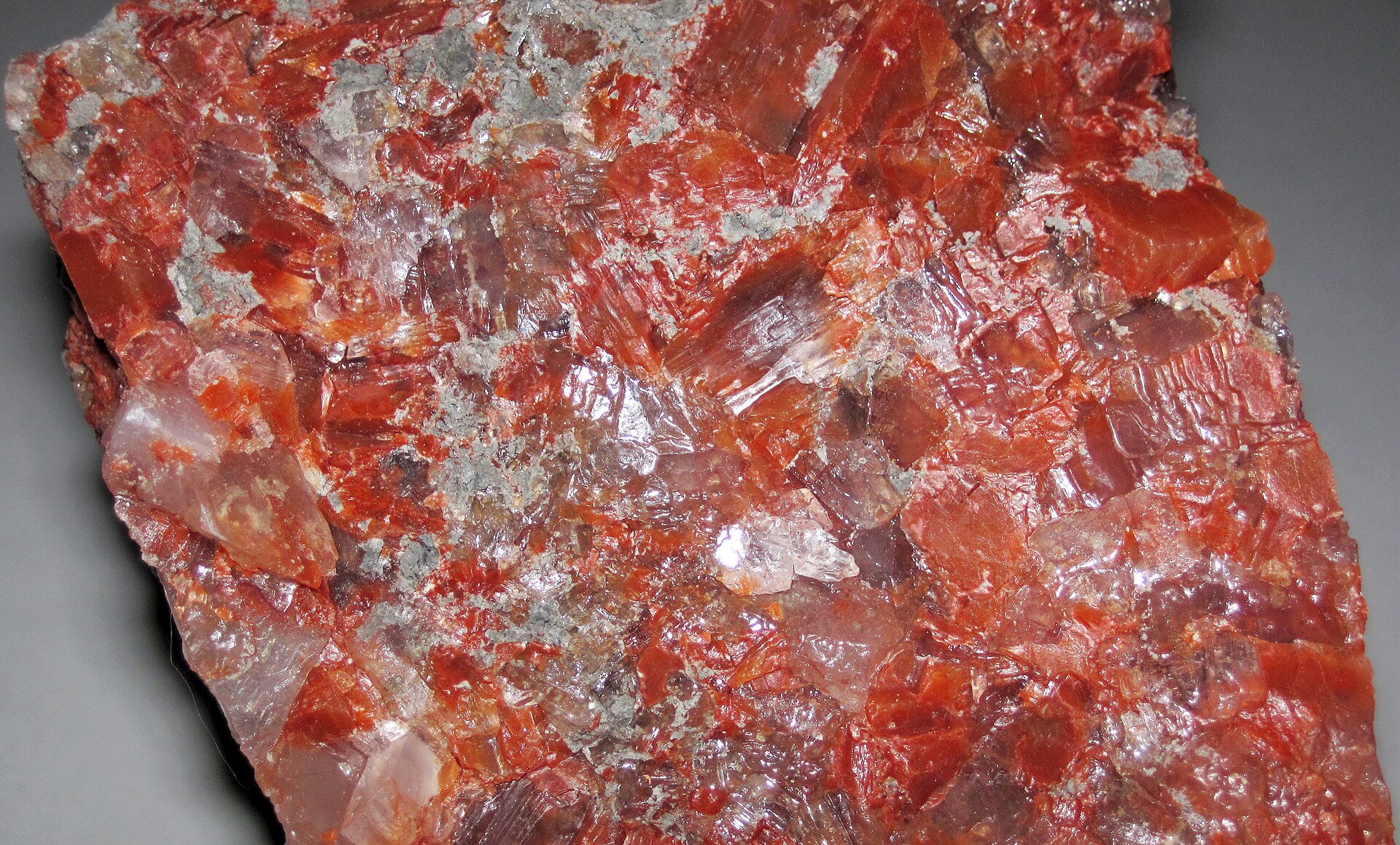
Evaporite rock from the Permian of New Mexico, USA. (collected in 1958) Evaporites are chemical sedimentary rocks that form by the evaporation of water and the — Photo: James St. John · CC BY 2.0
Polyhalite
A hydrated potassium-calcium-magnesium sulfate — an evaporite mineral increasingly mined as fertilizer.
Intro adapted from Wikipedia (CC BY-SA).
Polyhalite is an IMA-recognized mineral species in the sulfate class, with the chemical formula K₂Ca₂Mg(SO₄)₄·2H₂O.
It crystallizes in the triclinic crystal system (space group P-1).
Key properties: Mohs hardness 3.5; specific gravity 2.78; typically white or gray or pink or brown or red; white streak; Vitreous to resinous luster; refractive index 1.556; optically biaxial.
IMA symbol Plhl, grandfathered status — known before the IMA’s founding, named in 1817.
Common in marine salt deposits, where it may constitute the major component, present in billion-ton amounts; diagenetic in playa muds, formed from gypsum in the presence of Mg–K-rich solutions; rare as a fumarolic sublimate.
It is found associated with Halite, anhydrite, glauberite, carnallite, kieserite, langbeinite, vanthoffite.
Its name comes from the Greek for many and salt, in allusion to the mineral’s complex composition.
Collections: Everyday Minerals.