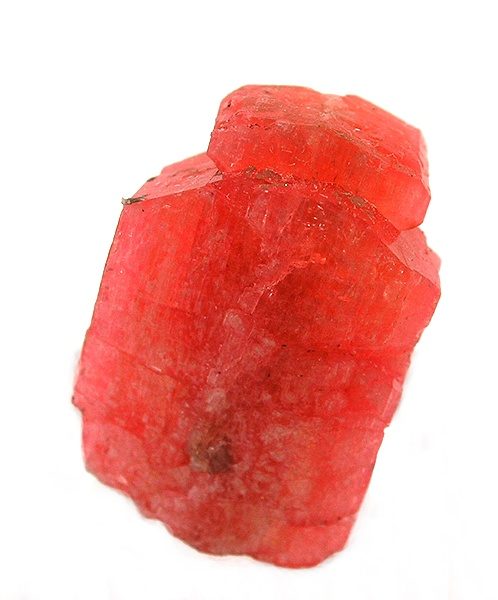
Serandite Locality: Mont Saint-Hilaire , Rouville RCM, Montérégie , Québec , Canada ( Locality at mindat.org ) Size: thumbnail, 2.4 x 1.7 x 1.1 cm Serandite One of the best thumbnail examples of this material I have ever seen! Complete and perfect all around! It is exquisite and has the best salmon-pink color (not quite as red as shown). More importantly, it has super LUSTER, which is really rare on serandite; AND good translucency when backlit. 2.4 x 1.7 x 1.1 cm — Photo: Robert M. Lavinsky · CC BY-SA 3.0
Serandite
Serandite is a mineral with formula Na(Mn2+,Ca)2Si3O8(OH). The mineral was discovered in Guinea in 1931 and named for J. M. Sérand. Serandite is generally red, brown, black or colorless.
Intro adapted from Wikipedia (CC BY-SA).
Serandite is an IMA-recognized mineral species in the silicate class, with the chemical formula NaMn²⁺₂Si₃O₈(OH).
It crystallizes in the triclinic crystal system (space group P-1). It is a member of the Pectolite structural group.
Key properties: Mohs hardness 5–5.5; specific gravity 3.34; White streak; Vitreous to greasy; fibrous aggregates are dull to silky luster; refractive index 1.681; optically biaxial.
IMA symbol Srd, IMA status: approved, named in 1931.
Found in sodalite xenoliths and pegmatites cutting syenites and nepheline syenites in an intrusive alkalic gabbro-syenite complex (Mont Saint-Hilaire, Canada); in vugs in phonolite (Point of Rocks, New Mexico, USA).
It is found associated with Sodalite, nepheline, aegirine, astrophyllite, arfvedsonite, eudialyte, leucophanite, analcime, villiaumite, fluorite (Rouma Isle, Guinea); analcime, aegirine.
The mineral was named to honor J.M. S¶erand, who aided the collection of type material.