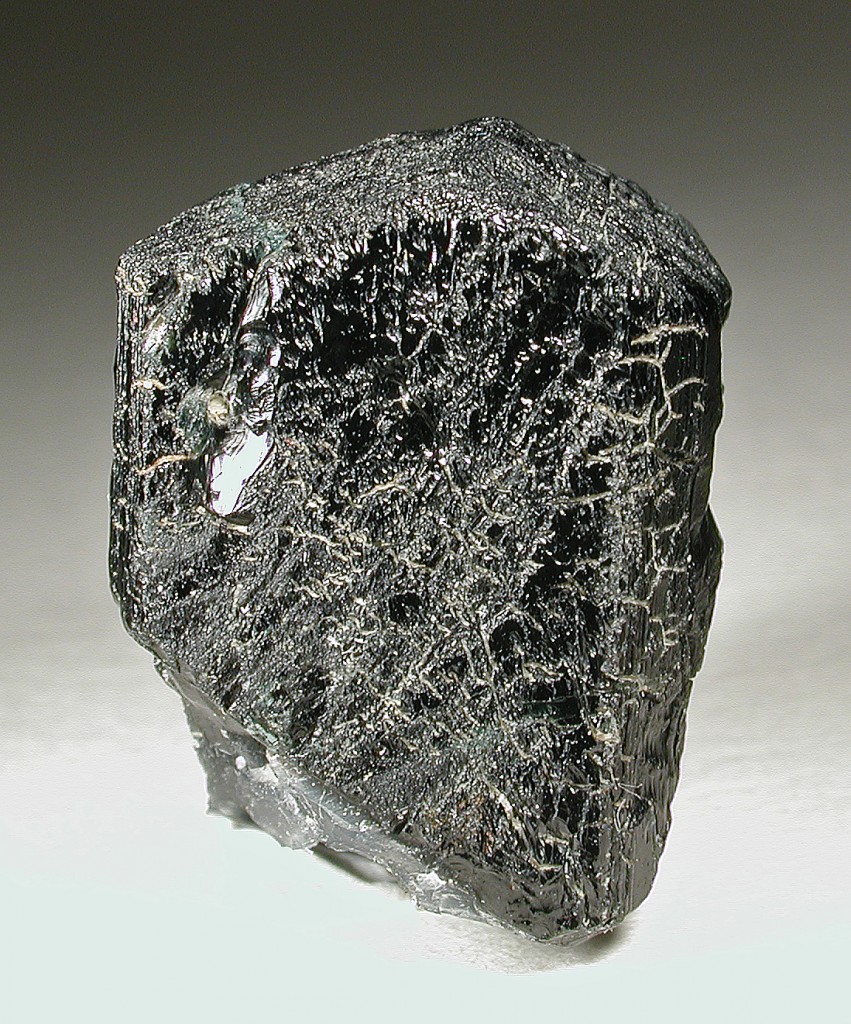
Serendibite (Dimensions: 16 mm x 13 mm x 8 mm) Locality: Mogok, Pyin Oo Lwin District, Mandalay Division, Burma (Myanmar) (Locality at mindat.org) Original desc — Photo: Kelly Nash · CC BY 3.0
Serendibite
Serendibite is an extremely rare silicate mineral that was first discovered in 1902 in Sri Lanka by Dunil Palitha Gunasekera and named after Serendib, the old Arabic name for Sri Lanka. The mineral is found in skarns associated with boron metasomatism of carbonate rocks where intruded by granite. Minerals occurring with serendibite include diopside, spinel, phlogopite, scapolite, calcite, tremolite, apatite, grandidierite, sinhalite, hyalophane, uvite, pargasite, clinozoisite, forsterite, warwickite and graphite.
Intro adapted from Wikipedia (CC BY-SA).
Serendibite is an IMA-recognized mineral species in the silicate class, with the chemical formula Ca₄[Mg₆Al₆]O₄[Si₆B₃Al₃O₃₆].
It crystallizes in the triclinic crystal system (space group P-1). It is a member of the Sapphirine structural group.
Key properties: Mohs hardness 6.5–7; specific gravity 3.42–3.52; typically blue or black; white streak; Vitreous luster; refractive index 1.704; optically biaxial.
IMA symbol Ser, grandfathered status — known before the IMA’s founding, named in 1903.
Found in skarns, affected by boron metasomatism, along the contact between carbonate rocks and granite, tonalite, or granulite.
It is found associated with Diopside, spinel, phlogopite, scapolite, calcite, tremolite, apatite, grandidierite, sinhalite, hyalophane, uvite, pargasite, clinozoisite, forsterite.
The name comes from the old Arabic name, Serendib, for Sri Lanka (Ceylon).
Collections: Gemstones, Rare & Remarkable.