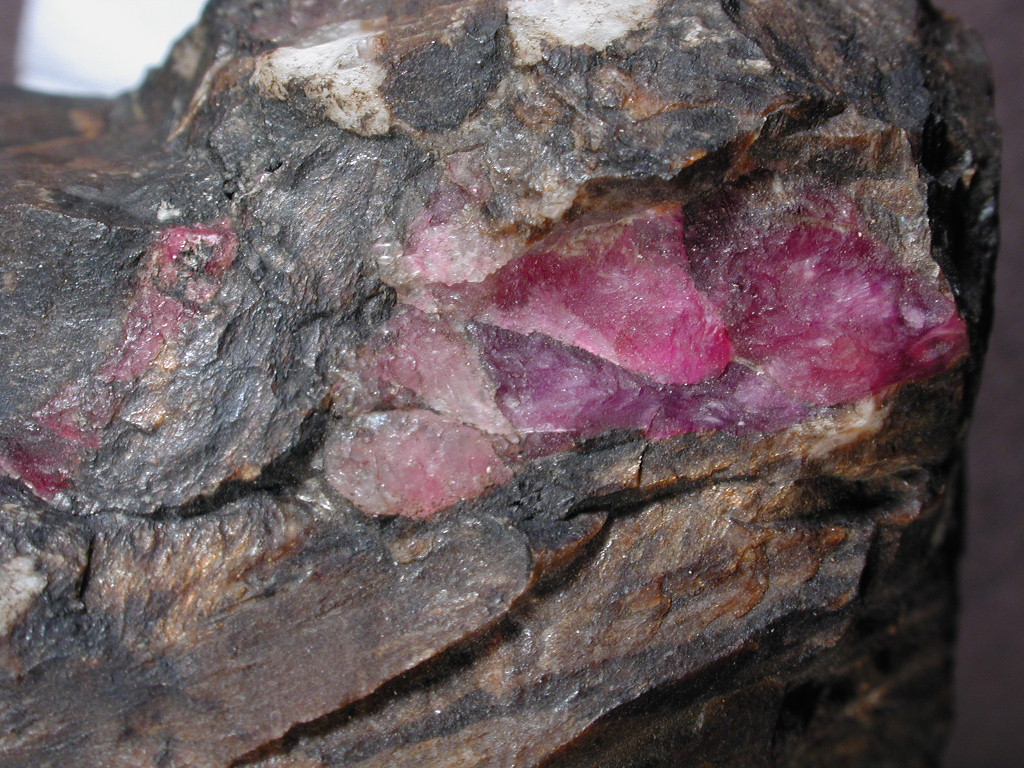
Sugilite Locality: Woods Mine (Wood's Rhodonite Mine), Tamworth, Darling County, New South Wales, Australia Sugilite clot is 1 cm across and is the largest kno — Photo: Matthew Goodwin · CC BY 3.0
Sugilite
Also known as: Luvulite.
A pink-to-purple lithium ring silicate — the 'new age stone' — discovered in Japan and famous from South Africa's Kalahari.
Intro adapted from Wikipedia (CC BY-SA).
Sugilite is an IMA-recognized mineral species in the silicate class, with the chemical formula KNa₂Fe³⁺₂(Li₃Si₁₂)O₃₀.
It crystallizes in the hexagonal crystal system (space group P6/mcc). It is a member of the Milarite structural group.
Key properties: Mohs hardness 6–6.5; specific gravity 2.74–2.79; typically purple or pink or brown; White streak; Vitreous luster; optically uniaxial.
IMA symbol Sug, IMA status: approved, named in 1974.
Found in an aegirine-bearing syenite stock in biotite granite (Iwagi Islet, Japan); in bedded manganese deposits (near Kuruman, South Africa).
It is found associated with Albite, aegirine, pectolite, titanite, allanite, andradite, zircon, apatite (Iwagi Islet, Japan).
The name refers to Professor Ken-ichi Sugi (1901–1948), Japanese petrologist, who discovered the mineral.
Collections: Gemstones, Collector Favorites.