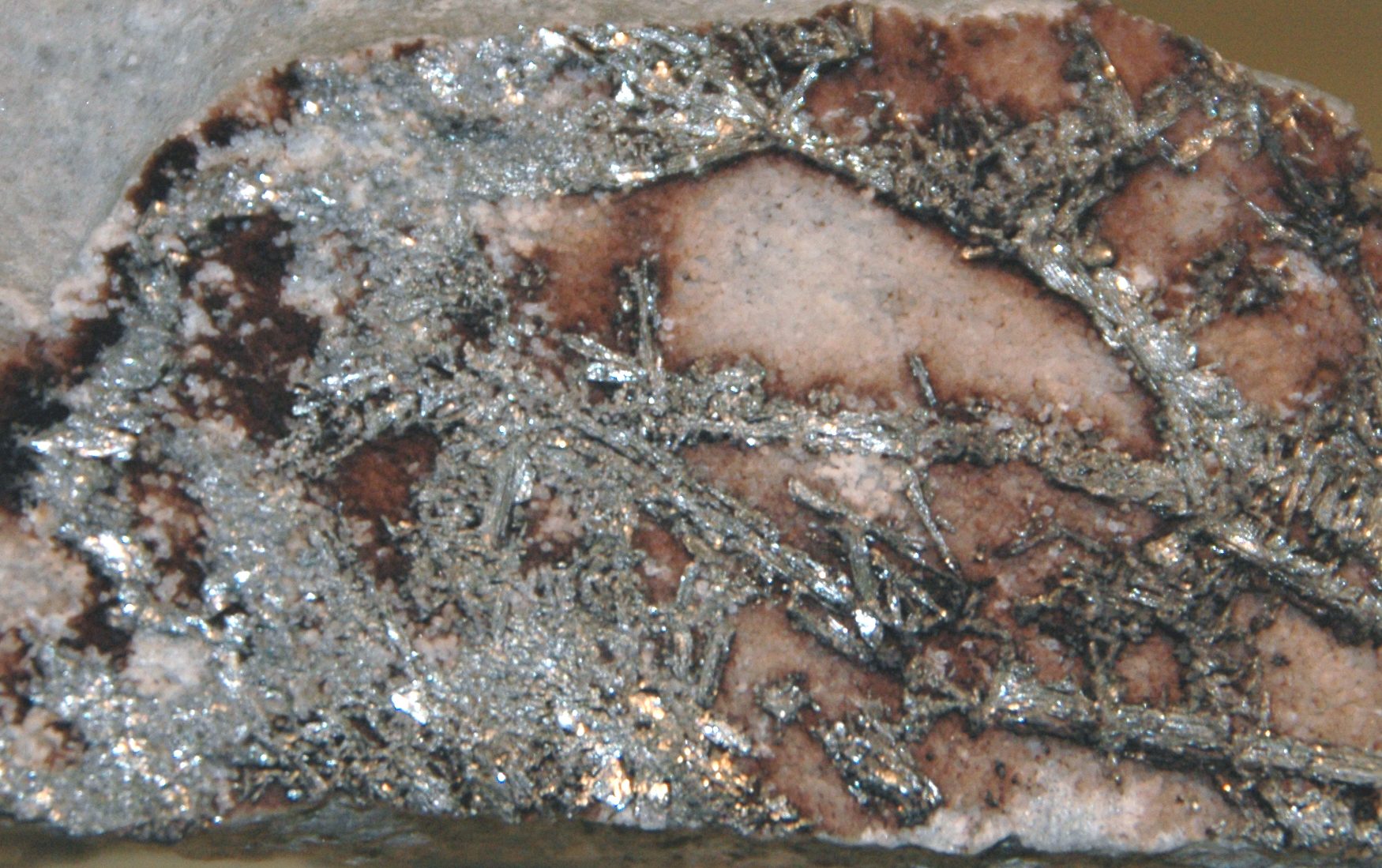
Sylvanite ((Au,Ag)2Te4) (silver-colored) from the Cripple Creek Diatreme (Early Oligocene, 32 Ma) of central Colorado, USA (ER # 1956, Ed Raines loan to Colorado School of Mines Geology Museum, Golden, Colorado, USA). The Cripple Creek Gold District of central Colorado, USA is famous for its unusual gold and silver mineralization. Precious metal mineralization occurs in the Cripple Creek Diatreme, the root zone of a deeply eroded volcano dating to the Early Oligocene (32 Ma). The dominant lithology at Cripple Creek is the scarce igneous rock phonolite, an alkaline, intermediate, extrusive igneous rock. Cripple Creek gold can be found in its native state (Au), but it typically occurs in the form of gold telluride minerals (for example, sylvanite - (Au,Ag)2Te4, calaverite - AuTe2, petzite - Ag3AuTe2, krennerite - (Au,Ag)Te2, and nagyagite - Pb5Au(Sb,Bi)Te2S6). Silver also occurs in some Cripple Creek minerals, including sylvanite, petzite, krennerite, hessite - Ag2Te, tennantite - (Cu,Ag,Fe,Zn)12As4S13, acanthite - Ag2S, and tetrahedrite - (Cu,Fe,Ag,Zn)12Sb4S13. — Photo: James St. John · CC BY 2.0
Sylvanite
Silver-gold telluride — the most common gold telluride — writing-like 'graphic tellurium' crystals.
Intro adapted from Wikipedia (CC BY-SA).
Sylvanite is an IMA-recognized mineral species in the sulfide class, with the chemical formula AgAuTe₄.
It crystallizes in the monoclinic crystal system (space group P2/c). It is a member of the Melonite structural group.
Key properties: Mohs hardness 1.5–2; specific gravity 8.16; Steel-gray to silver-white streak; Metallic, brilliant luster.
IMA symbol Syv, grandfathered status — known before the IMA’s founding, named in 1832.
Most commonly in low-temperature hydrothermal veins; also in medium- and high-temperature deposits, typically among the last minerals formed.
It is found associated with Gold, calaverite, krennerite, altaite, hessite, petzite, acanthite, pyrite, galena, sphalerite, chalcopyrite, quartz, “chalcedony”, fluorite.
The name comes from TranSYLVANia, Romania where it was first found, and in allusion to the element tellurium (sylvanium, a name early proposed for the element), which the mineral contains.