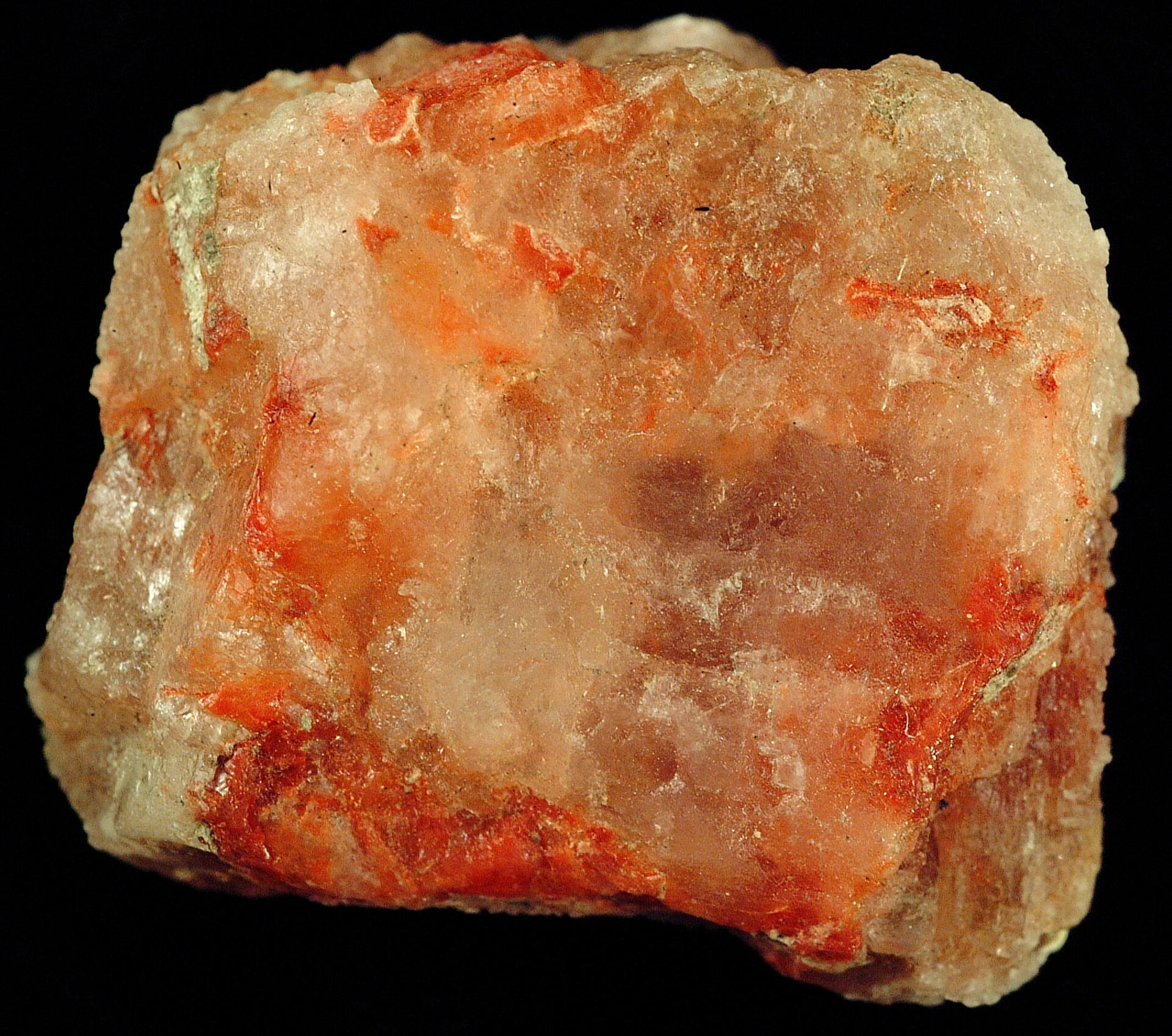
Halite (NaCl) and sylvite (KCl) are often found together. Although similar in chemistry and crystal structure, their mutual solubility is limited, so compositio — Photo: Darla Sondrol · CC0
Sylvite
Also known as: Sylvine.
Potassium chloride — the potash ore mineral, isomorphous with halite and similarly water-soluble.
Intro adapted from Wikipedia (CC BY-SA).
Sylvite is an IMA-recognized mineral species in the halide class, with the chemical formula KCl.
It crystallizes in the cubic crystal system (space group Fm3m). It is a member of the Rocksalt structural group.
Key properties: Mohs hardness 2; specific gravity 1.993; typically colorless or white or gray or blue or yellow or red; white streak; Vitreous luster; refractive index 1.49; optically isotropic.
IMA symbol Syl, grandfathered status — known before the IMA’s founding, named in 1823.
Found in sedimentary basins, forming thick bedded deposits with halite; as a sublimate in volcanic fumaroles; in nitrate beds and cave deposits; a product of burning coal.
It is found associated with Halite, kieserite, kainite, carnallite, polyhalite, gypsum, anhydrite.
The name comes from the alchemical Sal digestivus Sylvii or Salt of Sylvius, the digestive salt of François Sylvius de le Boë (1614–1672), Dutch physician and chemist of Leiden, Netherlands.
Collections: Everyday Minerals.