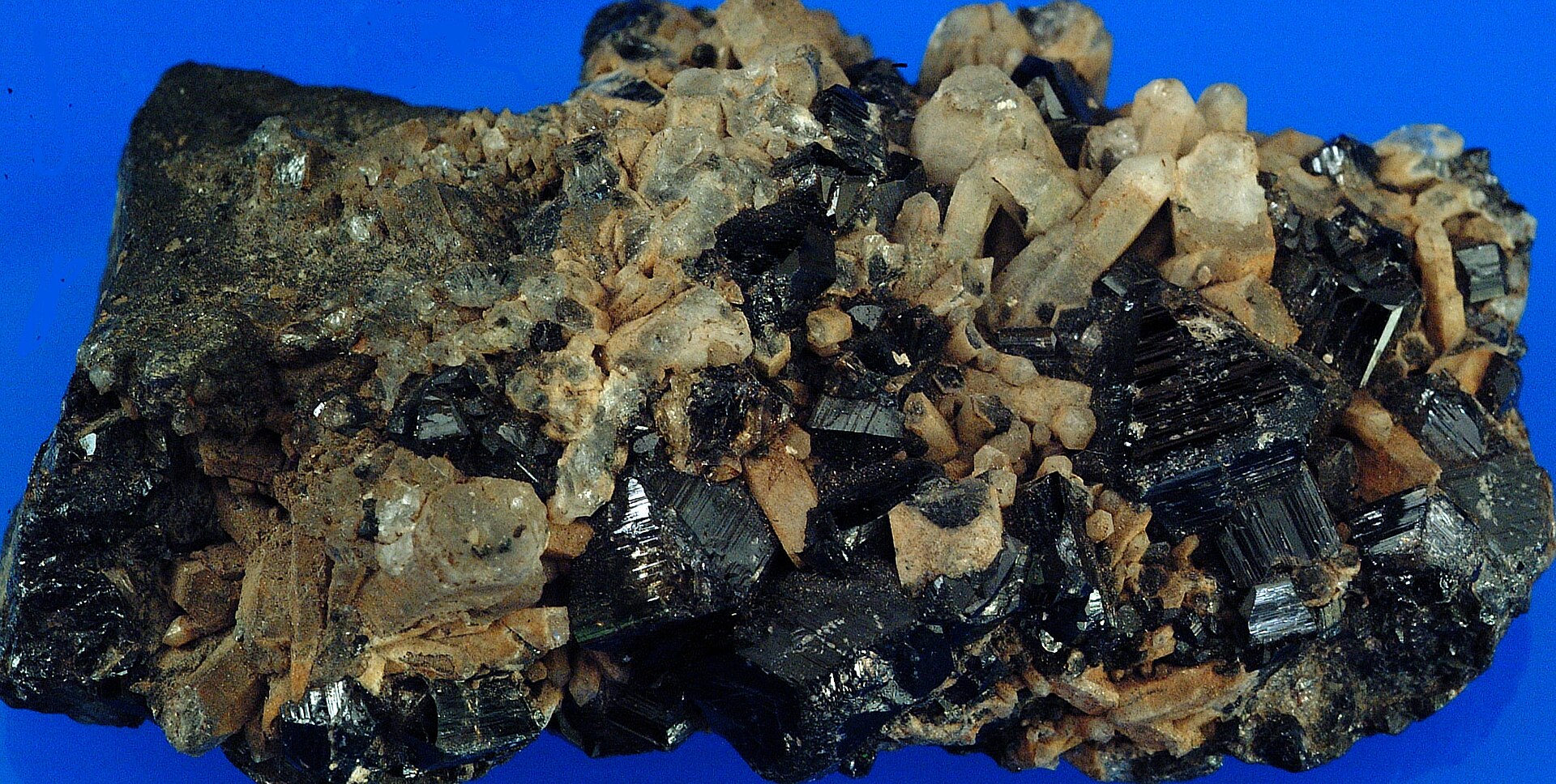
Thorite is a thorium silicate, (Th,U)SiO4, often containing significant amounts of uranium. Here, black thorite crystals are seen with quartz. Both minerals sho — Photo: Nessa Eull · CC0
Thorite
The commonest thorium mineral — a radioactive tetragonal silicate isostructural with zircon.
Intro adapted from Wikipedia (CC BY-SA).
Thorite is an IMA-recognized mineral species in the silicate class, with the chemical formula Th(SiO₄).
It crystallizes in the tetragonal crystal system (space group I4_1/amd). It is a member of the Zircon structural group.
Key properties: Mohs hardness 4.5–5; specific gravity 6.63–7.2; typically brown or black or yellow or orange; Light orange to dark brown streak; Vitreous to resinous or greasy luster; optically uniaxial.
IMA symbol Thr, grandfathered status — known before the IMA’s founding, named in 1817.
An accessory mineral in felsic igneous rocks and their associated pegmatites. As a detrital mineral in sediments.
It is found associated with Zircon, monazite, gadolinite, fergusonite, uraninite, yttrialite, pyrochlore.
The name refers to its content of thorium, in turn named for Thor, Scandinavian god of war.
Collections: Collector Favorites, Rare & Remarkable.