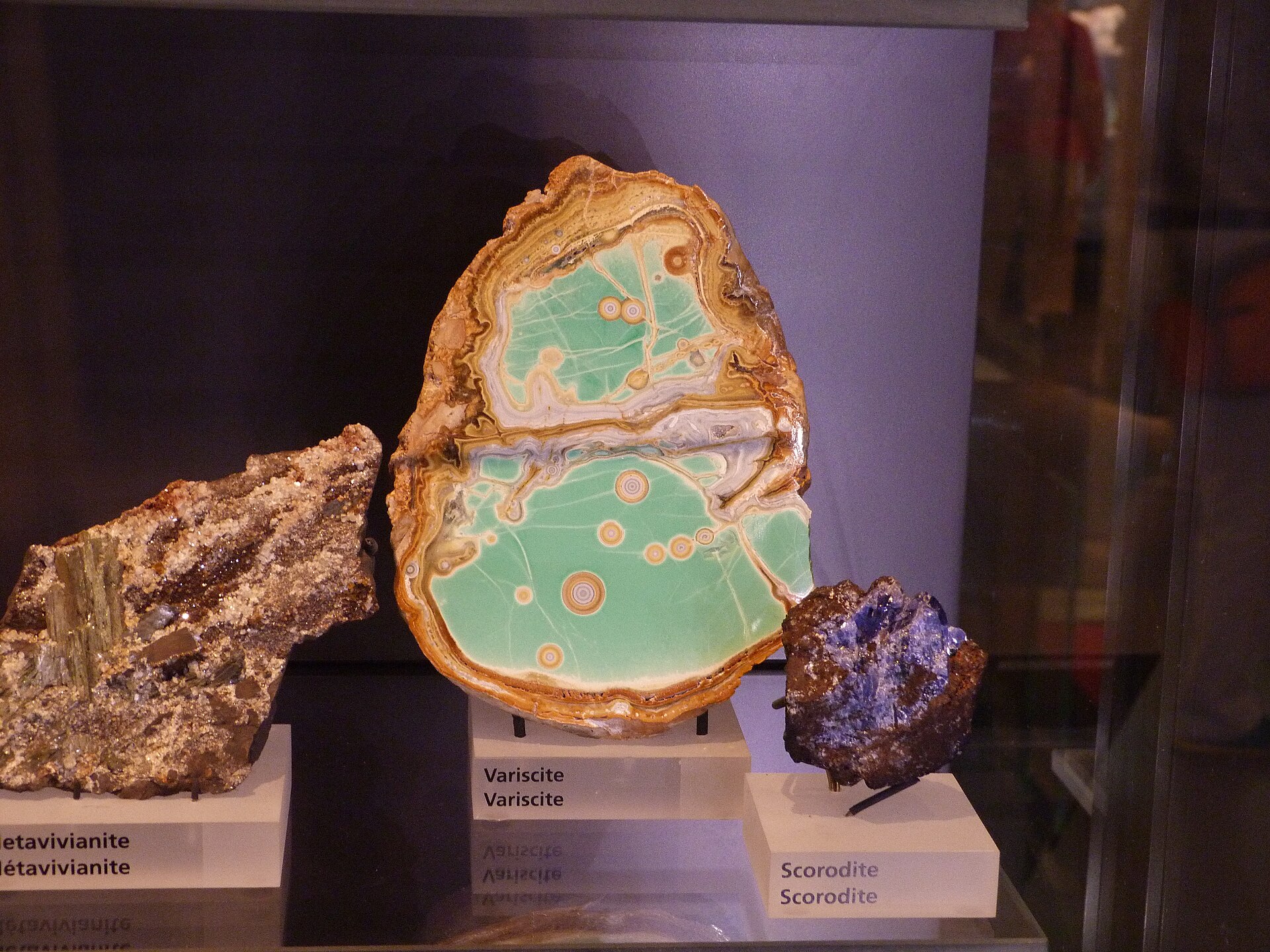
Variscite (center of image), Metavivianite (left) und Scorodite (right). Exhibited at the Royal Ontario Museum — Photo: S. Rae from Scotland, UK · CC BY 2.0
Variscite
Also known as: Utahlite.
A hydrated aluminium phosphate — the greener 'cousin of turquoise', colored by traces of chromium.
Intro adapted from Wikipedia (CC BY-SA).
Variscite is an IMA-recognized mineral species in the phosphate class, with the chemical formula Al(PO₄)·2H₂O.
It crystallizes in the orthorhombic crystal system (space group Pbca).
Key properties: Mohs hardness 3.5–4.5; specific gravity 2.57–2.61; typically green; White streak; Vitreous to waxy luster; refractive index 1.582; optically biaxial.
IMA symbol Var, IMA status: approved, named in 1837.
Typically deposited from phosphate-bearing waters in contact with aluminous rocks. On islands and in caves, the phosphate provided by decomposition of guano.
It is found associated with Crandallite, carbonate-fluorapatite, wardite, millisite, gordonite, montgomeryite, overite, kolbeckite, goyazite (Little Green Monster mine, Utah, USA).
The name comes from Variscia, an old name for Vogtland, the district in Germany which was the original source for the mineral.
Collections: Gemstones, Collector Favorites.