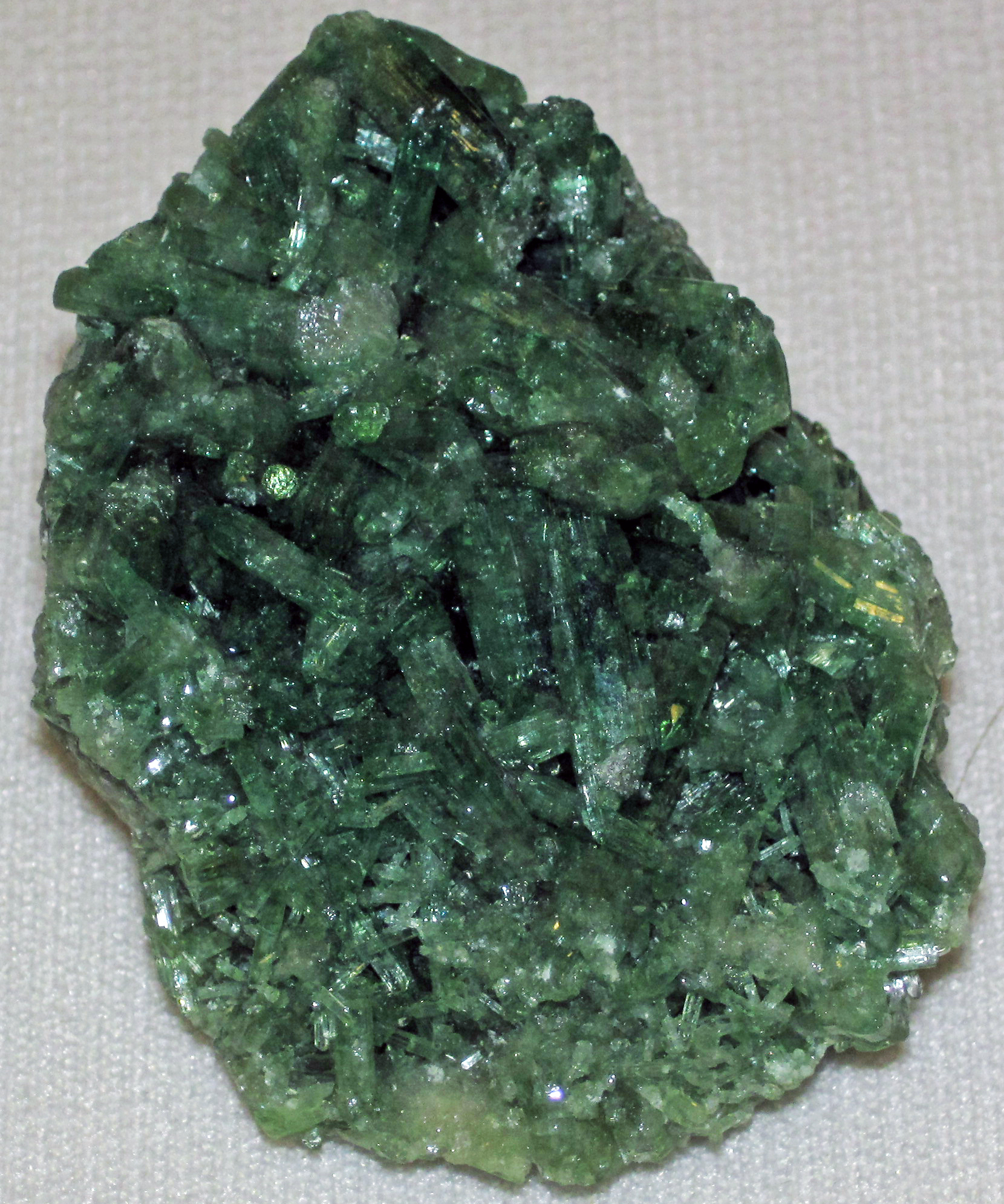
A mineral is a naturally-occurring, solid, inorganic, crystalline substance having a fairly definite chemical composition and having fairly definite physical pr — Photo: James St. John · CC BY 2.0
Vesuvianite
Also known as: Idocrase, Californite.
A complex calcium silicate of contact-metamorphosed limestone — 'idocrase' — forming green tetragonal crystals first found on Vesuvius.
Intro adapted from Wikipedia (CC BY-SA).
Vesuvianite is an IMA-recognized mineral species in the silicate class, with the chemical formula (Ca,Na)₁₉(Al,Mg,Fe)₁₃(SiO₄)₁₀(Si₂O₇)₄(OH,F,O)₁₀.
It crystallizes in the tetragonal crystal system (space group P4/nnc). It is a member of the Vesuvianite structural group.
Key properties: Mohs hardness 6.5; specific gravity 3.32–3.43; typically green or brown or yellow or blue or colorless; White streak; Vitreous to resinous luster; refractive index 1.725; optically uniaxial.
IMA symbol Ves, IMA status: approved, named in 1795.
Found in skarns developed during contact or regional metamorphism of limestones; in garnetized gabbros, mafic and ultramafic rocks, and serpentinites; uncommon in alkalic igneous rocks.
It is found associated with Grossular, diopside, wollastonite, epidote, scapolite, spinel, calcite.
The name refers to its occurrence at Vesuvius, Italy.
Collections: Collector Favorites, Gemstones.