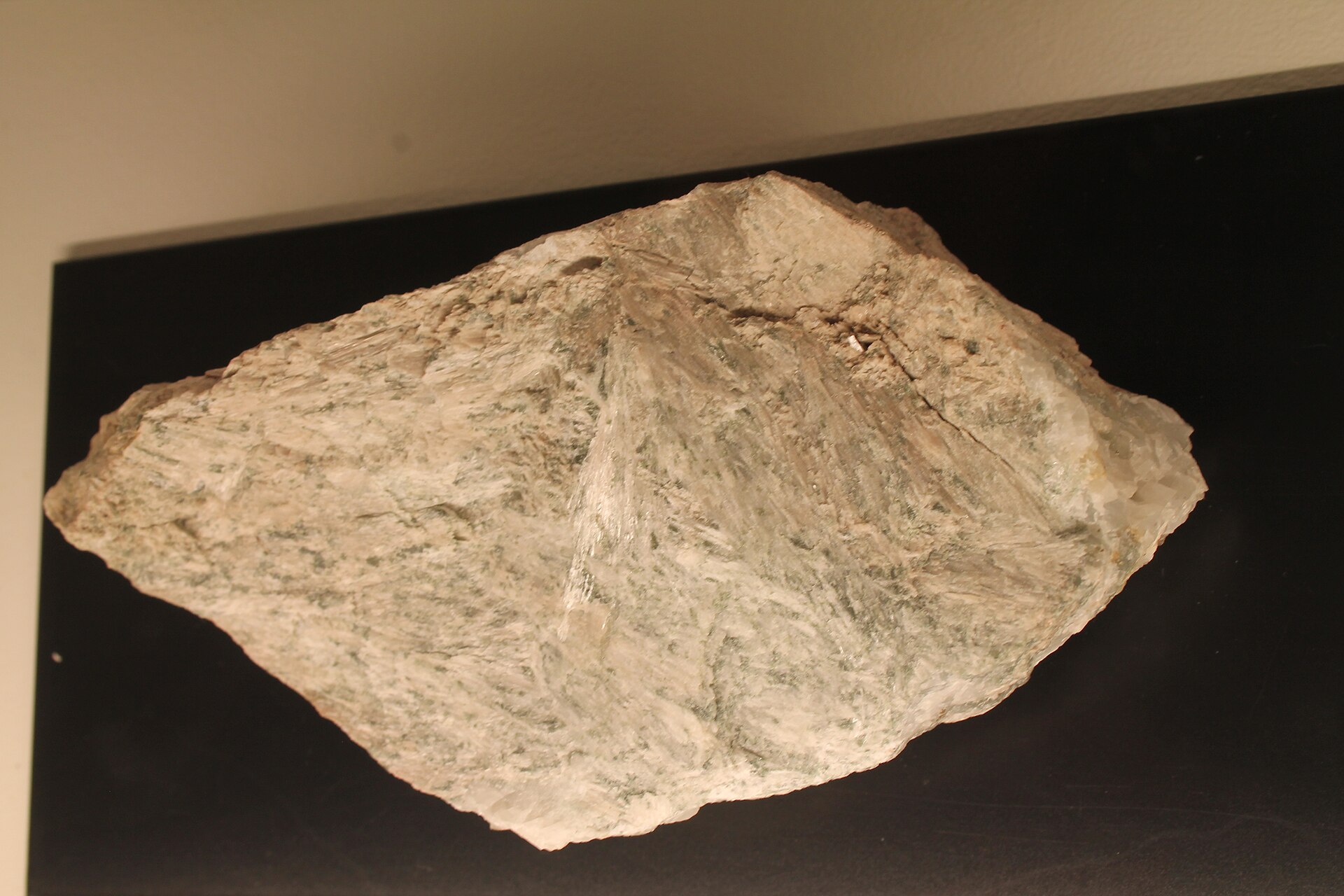
Wollastonite, en provenance de Saint-Nazaire (France), au Muséum de Nantes — Photo: Koreller · CC BY-SA 4.0
Wollastonite
White calcium silicate — formed when impure limestone is heated — used in ceramics and as an asbestos substitute.
Intro adapted from Wikipedia (CC BY-SA).
Wollastonite is an IMA-recognized mineral species in the silicate class, with the chemical formula CaSiO₃.
It crystallizes in the triclinic crystal system (space group P2_1/a). It is a member of the Wollastonite structural group.
Key properties: Mohs hardness 4.5–5; specific gravity 2.86–3.09; typically white or colorless or gray; White streak; Vitreous, pearly on cleavage luster; refractive index 1.636; optically biaxial.
IMA symbol Wo, IMA status: approved, named in 1818.
Common in thermally metamorphosed siliceous carbonates, the intruding igneous rock, and skarn deposits along their contact; also in some alkalic igneous rocks and carbonatites.
It is found associated with Calcite, grossular, diopside, vesuvianite, º akermanite, merwinite, larnite, spurrite.
The name refers to William Hyde Wollaston (1766–1828), English chemist and mineralogist.
Collections: Everyday Minerals, Collector Favorites.