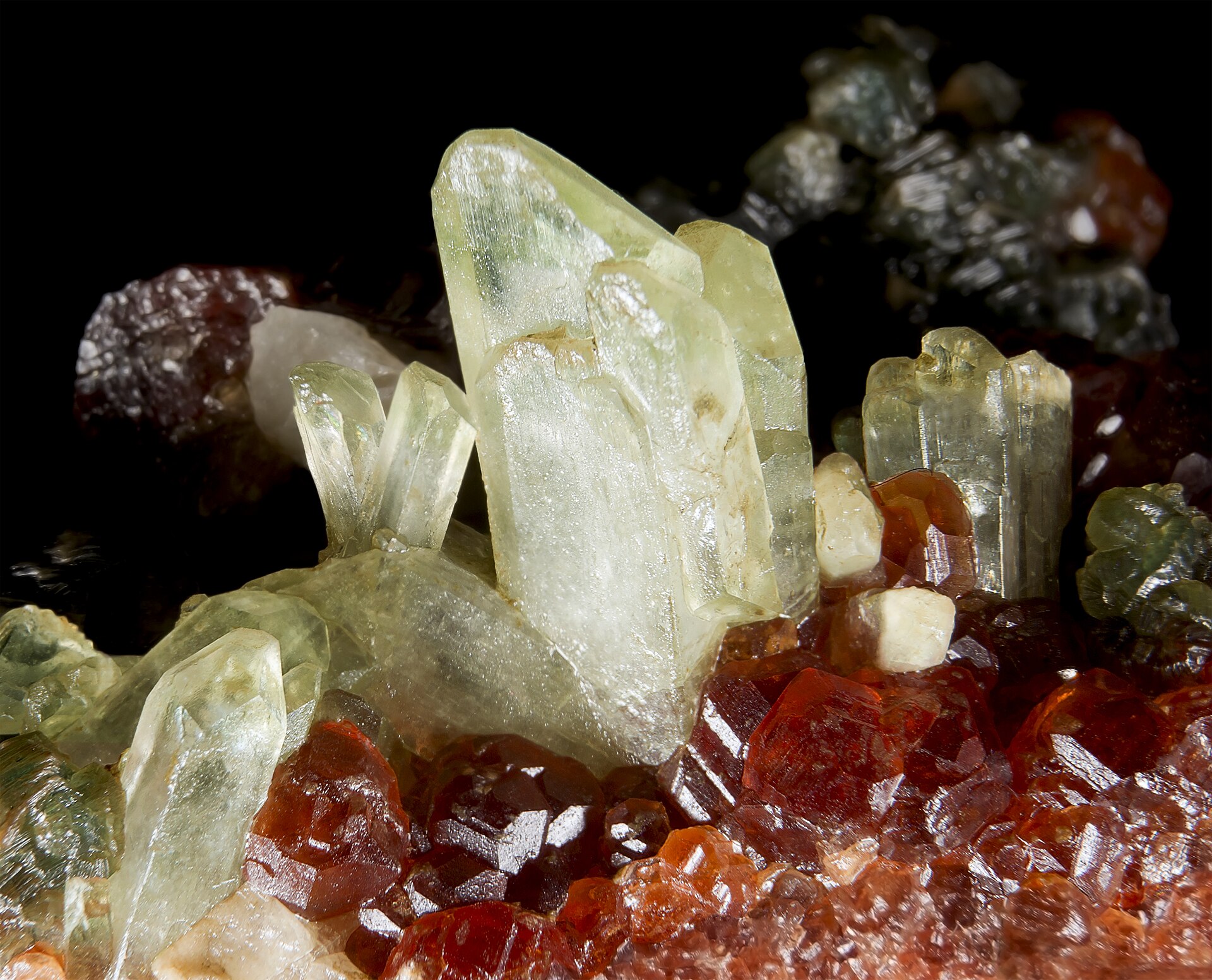
Diopside Hessonite Clinochlore Locality: Bellecombe, Châtillon, Aosta Valley, Italy Size : prismatic green crystal of diopside up to 1.16 cm — Photo: Didier Descouens · CC BY-SA 3.0
Diopside
Also known as: Chrome diopside (green var.), Violane.
A common monoclinic pyroxene of the magnesium-calcium silicate series — found in igneous and metamorphic rocks, occasionally a gem.
Intro adapted from Wikipedia (CC BY-SA).
Diopside is an IMA-recognized mineral species in the silicate class, with the chemical formula CaMgSi₂O₆.
It crystallizes in the monoclinic crystal system (space group C2/c). It is a member of the Pyroxene structural group.
Key properties: Mohs hardness 5.5–6.5; specific gravity 3.22–3.38; typically green or white or brown or colorless or black or yellow; White, gray, gray-green streak; Vitreous or dull luster; refractive index 1.693; optically biaxial.
IMA symbol Di, IMA status: approved, named in 1800.
Typical of metamorphosed siliceous Ca, Mg-rich rocks of the pyroxene-hornfels or epidote-amphibolite facies; common in skarns, Ca, Mg-rich gneisses and schists, and some kimberlites and peridotites.
It is found associated with Calcite, forsterite, chondrodite, monticellite, clinohumite, scapolite, wollastonite, grossular, vesuvianite, tremolite, quartz.
Its name comes from the Greek for double and appearance, apparently for two possible orientations of the prism zone.
Collections: Collector Favorites, Gemstones.