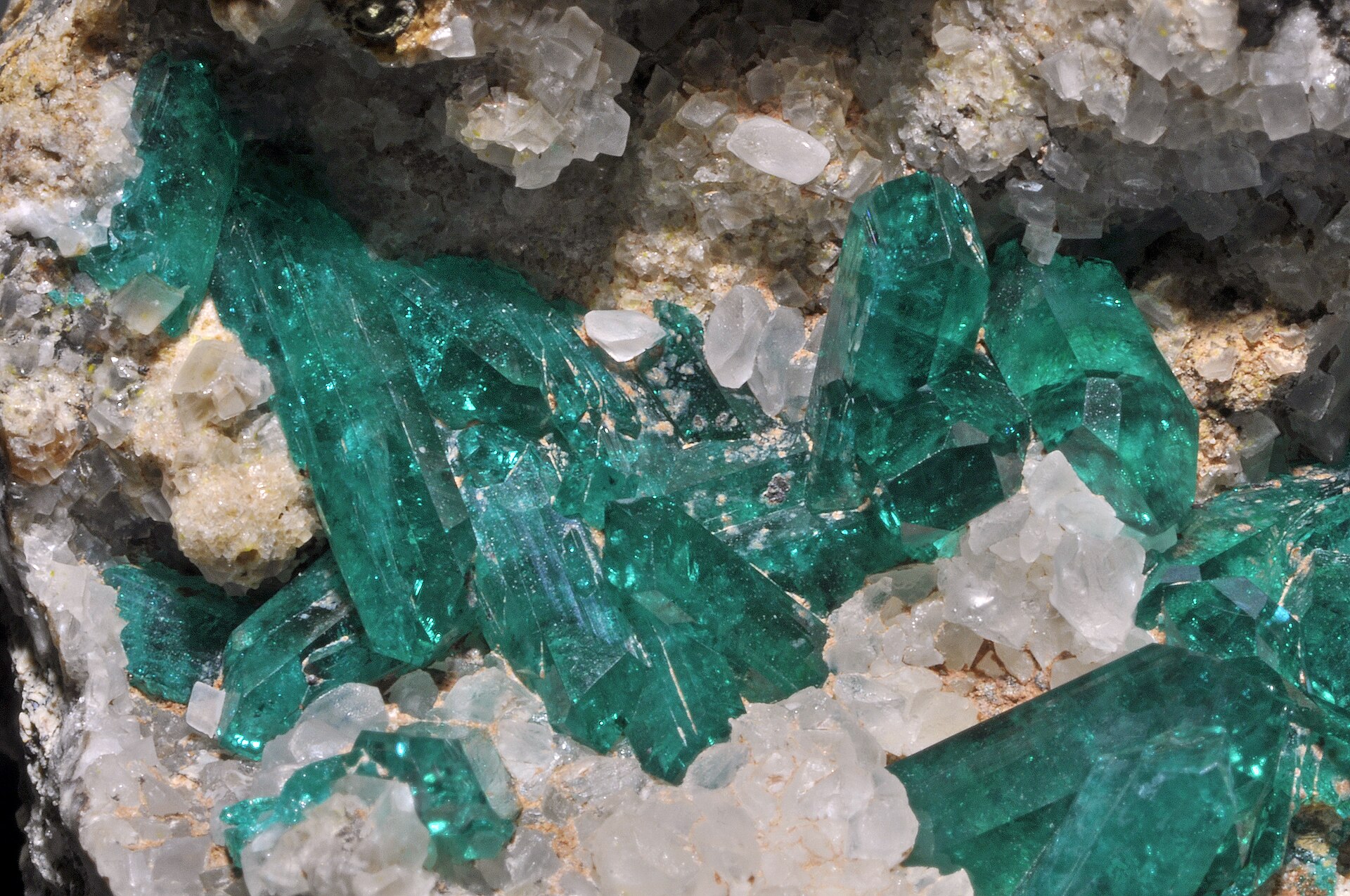
crystals of dioptase, crystals of calcite : Kandesi, Kaokoveld Plateau, Kunene Region, Namibia — Photo: Parent Géry · CC BY-SA 3.0
Dioptase
Also known as: Emerald copper.
An intense emerald-green copper cyclosilicate — one of the most vivid minerals known, too soft and brittle for mainstream gems.
Intro adapted from Wikipedia (CC BY-SA).
Dioptase is an IMA-recognized mineral species in the silicate class, with the chemical formula CuSiO₃·H₂O.
It crystallizes in the hexagonal crystal system (space group R-3).
Key properties: Mohs hardness 5; specific gravity 3.28–3.35; typically green; Green streak; Vitreous luster; refractive index 1.681; optically uniaxial.
IMA symbol Dpt, grandfathered status — known before the IMA’s founding, named in 1797.
Found in the oxidized zone of some copper deposits.
It is found associated with Chrysocolla, malachite, mimetite, wulfenite, cerussite, hemimorphite, fluorite, quartz.
Its name comes from the Greek for through and to see, as the cleavage directions may be seen on looking through the crystal.
Collections: Collector Favorites, Gemstones.