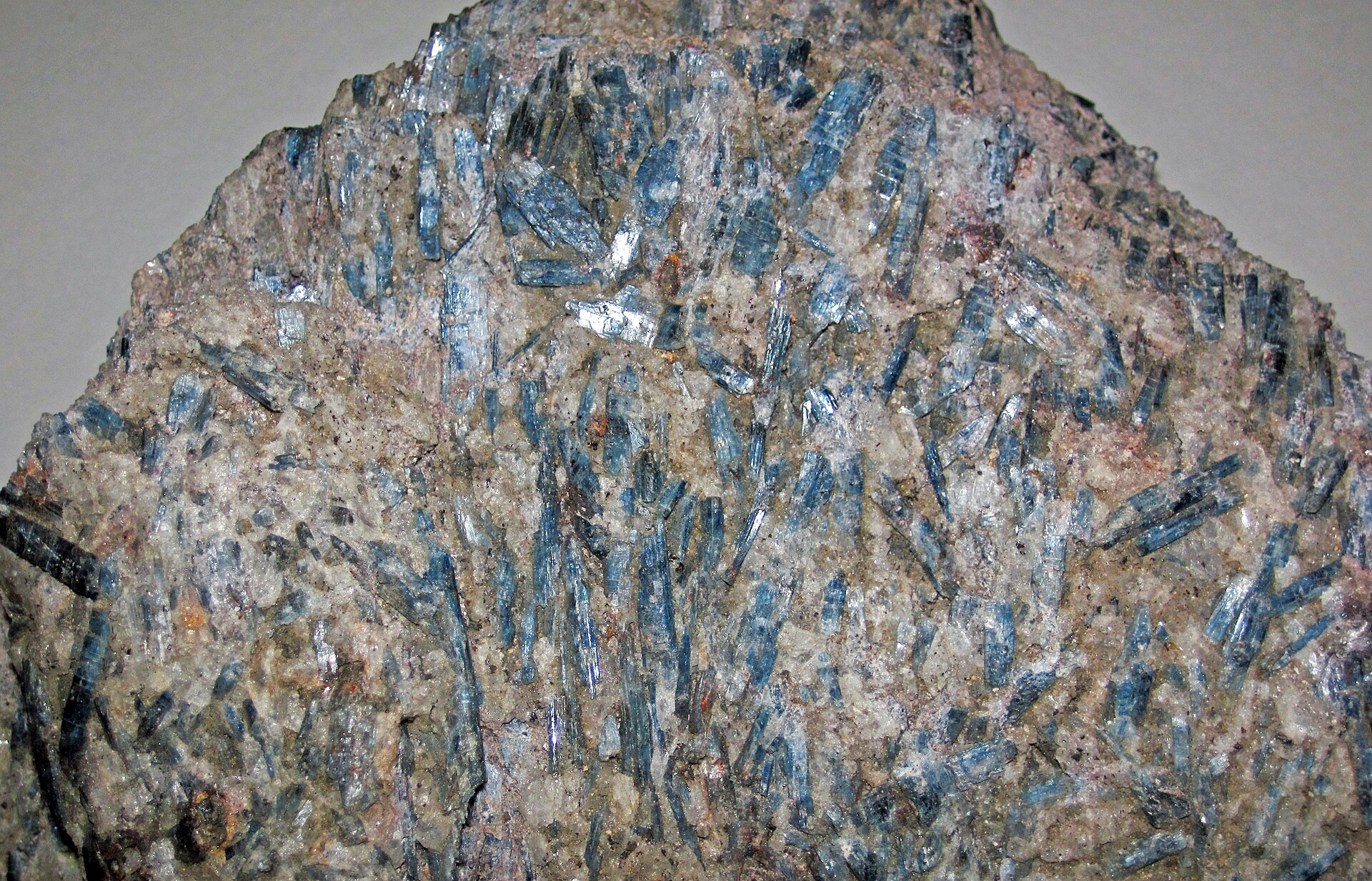
Metamorphic rocks result from intense alteration of any previously existing rocks by heat and/or pressure and/or chemical change. This can happen as a result o — Photo: James St. John · CC BY 2.0
Kyanite
Also known as: Disthene.
The high-pressure polymorph of Al₂SiO₅ — bladed blue crystals whose presence marks rocks metamorphosed deep in the crust.
Intro adapted from Wikipedia (CC BY-SA).
Kyanite is an IMA-recognized mineral species in the silicate class, with the chemical formula Al₂OSiO₄.
It crystallizes in the triclinic crystal system (space group P-1).
Key properties: Mohs hardness 5.5–7; specific gravity 3.53–3.65; typically blue or green or white or gray or orange; white streak; Vitreous to pearly luster; refractive index 1.723; optically biaxial.
IMA symbol Ky, IMA status: approved, named in 1789.
Found in gneisses, schists, included pegmatites, and quartz veins, from moderately high-pressure regional metamorphism of principally pelitic rocks; detrital in sedimentary rocks.
It is found associated with Staurolite, andalusite, sillimanite, talc, \hornblende, " gedrite, mullite, corundum.
Its name comes from the Greek for blue, in allusion to its common dark blue color.
Collections: Collector Favorites, Gemstones.