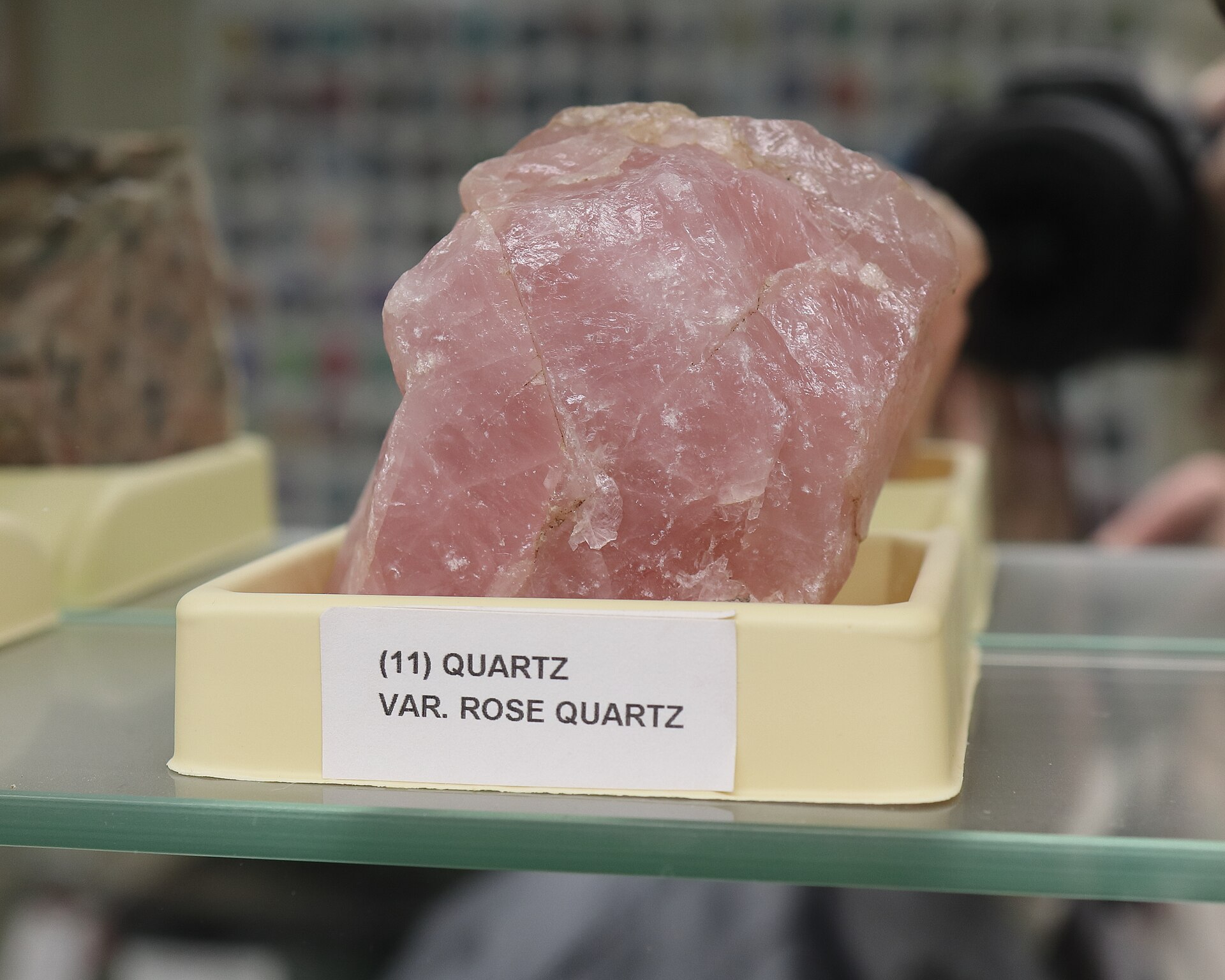
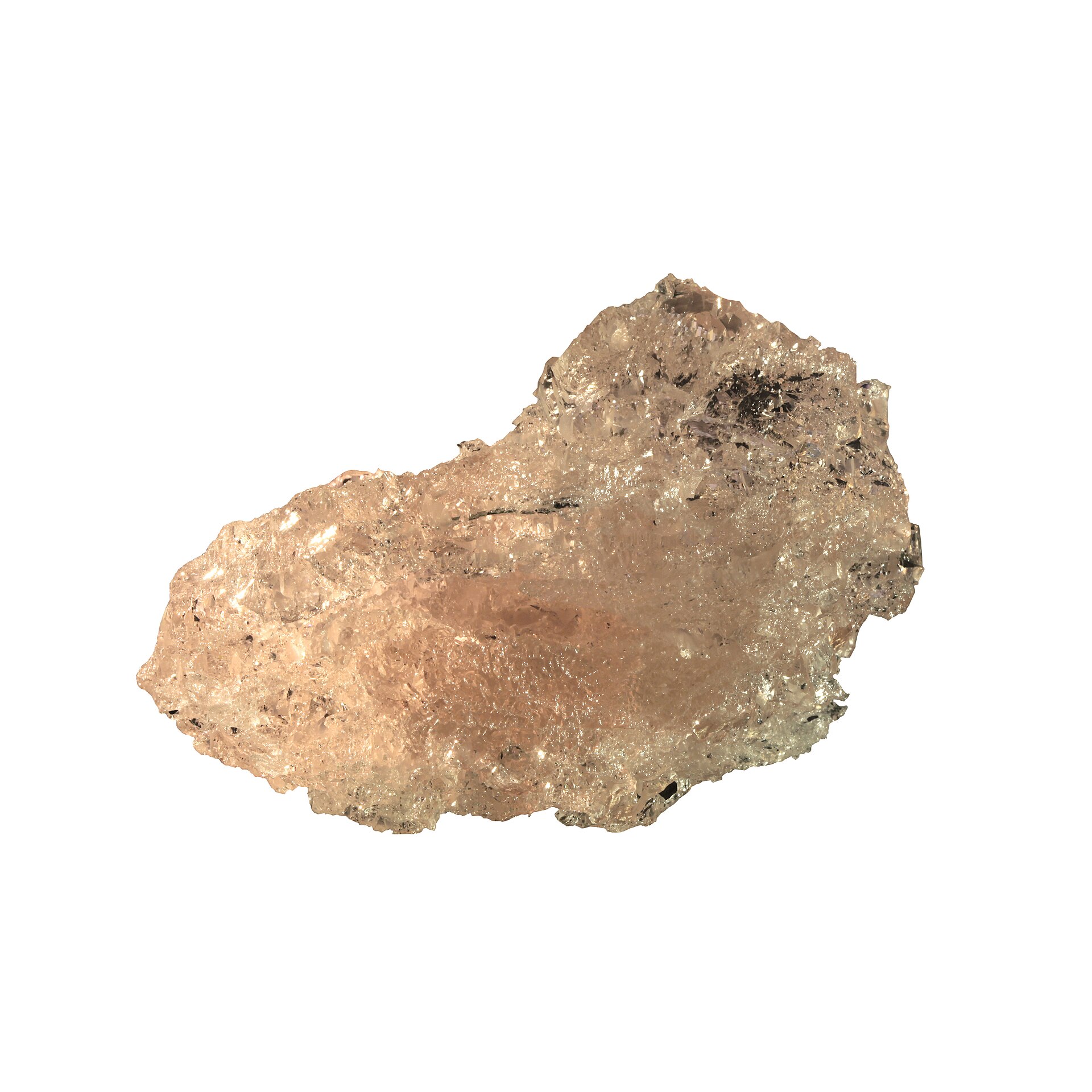
Rose quartz — massive, translucent pink quartz from a pegmatite — Photo: Peter Cooper Jr. · CC0
What is Rose Quartz?
Rose quartz is the soft-pink, usually massive variety of quartz — the ‘love stone’ of the gem trade, and one of the few minerals whose color comes not from its own chemistry but from another mineral entirely.
Dissolve rose quartz in acid and a felt of pink fibers a fraction of a micron wide remains — a nanoscopic material related to dumortierite. Those fibers, scattered through the quartz by the trillion, absorb and scatter light and paint the whole stone pink. That is also why rose quartz is almost never clear: the same fibers that color it cloud it.
A much rarer, fully crystalline sibling — properly called ‘pink quartz’ — grows real crystal points in a few pegmatites and owes its color to radiation-activated phosphorus–aluminum centers instead.
Physical Properties
The full data table is in the panel alongside. Here’s what those numbers actually mean.
Color. From the palest blush to a saturated rose-pink; Madagascar material can be startlingly rich. The color is stable in normal wear, though deep pinks can pale after long, strong sun exposure.
Clarity. Expect cloudiness — swirls and milky ‘white rose’ patches are the norm, not flaws. Clean, facetable rose quartz is scarce, so most stones are cut as cabochons, beads and spheres.
Star stones. Rose quartz carrying aligned micro-inclusions (rutile needles along with the pink fibers) can show a six-rayed star when cut en cabochon and lit from above — asterism, the same effect seen in star sapphire.
How & Where It Forms
Rose quartz grows in the silica-rich cores of granitic pegmatites and in massive hydrothermal veins, where slow cooling lets quartz coarsen into solid pink masses. The dumortierite-like fibers precipitated along with the quartz, threading through it as it crystallized.
Classic sources are pegmatite districts — Madagascar's central highlands, the pegmatite fields of Minas Gerais, the Black Hills of South Dakota, and Namibia's Spitzkoppe granites. The rare euhedral ‘pink quartz’ crystals come almost entirely from a handful of pegmatites in Brazil and Maine.
Often grows alongside:
What It’s Used For
How to Identify It
Rose quartz is the translucent pink massive quartz — pink color, glassy luster on broken surfaces, hardness 7, no cleavage, white streak.
Pink calcite fizzes in dilute acid and scratches far more easily; morganite and pink tourmaline are transparent crystals with real faces; pink opal is softer and lighter. If it is pink, massive, and scratches glass, it is almost certainly rose quartz.
| Looks like… | But differs because… | Quick test |
|---|---|---|
| Calcite | Pink calcite is much softer (3), has rhombohedral cleavage and fizzes in dilute acid | Vinegar drop |
| Morganite | Transparent hexagonal beryl crystals, slightly harder (7.5–8) | Crystal form |
| Tourmaline | Pink elbaite is transparent, strongly pleochroic and grows striated prisms | Prism striations |
| Opal | Pink opal is amorphous, softer (5.5–6.5) and lighter | Hardness |
Where It’s Found
Notable localities for fine specimens:
Gallery
Photographs from Wikimedia Commons contributors — click a credit on the main image for the source and license.
Related Minerals
Others in the same family and minerals it commonly grows alongside.
References & Further Reading
- Dana’s New Mineralogy, 8th ed. Silica group, tectosilicates.
- Mindat.org — Rose Quartz mineral data and locality records.
- Wikipedia — Rose quartz.
Last reviewed 2026-09-14 · How to cite this page.