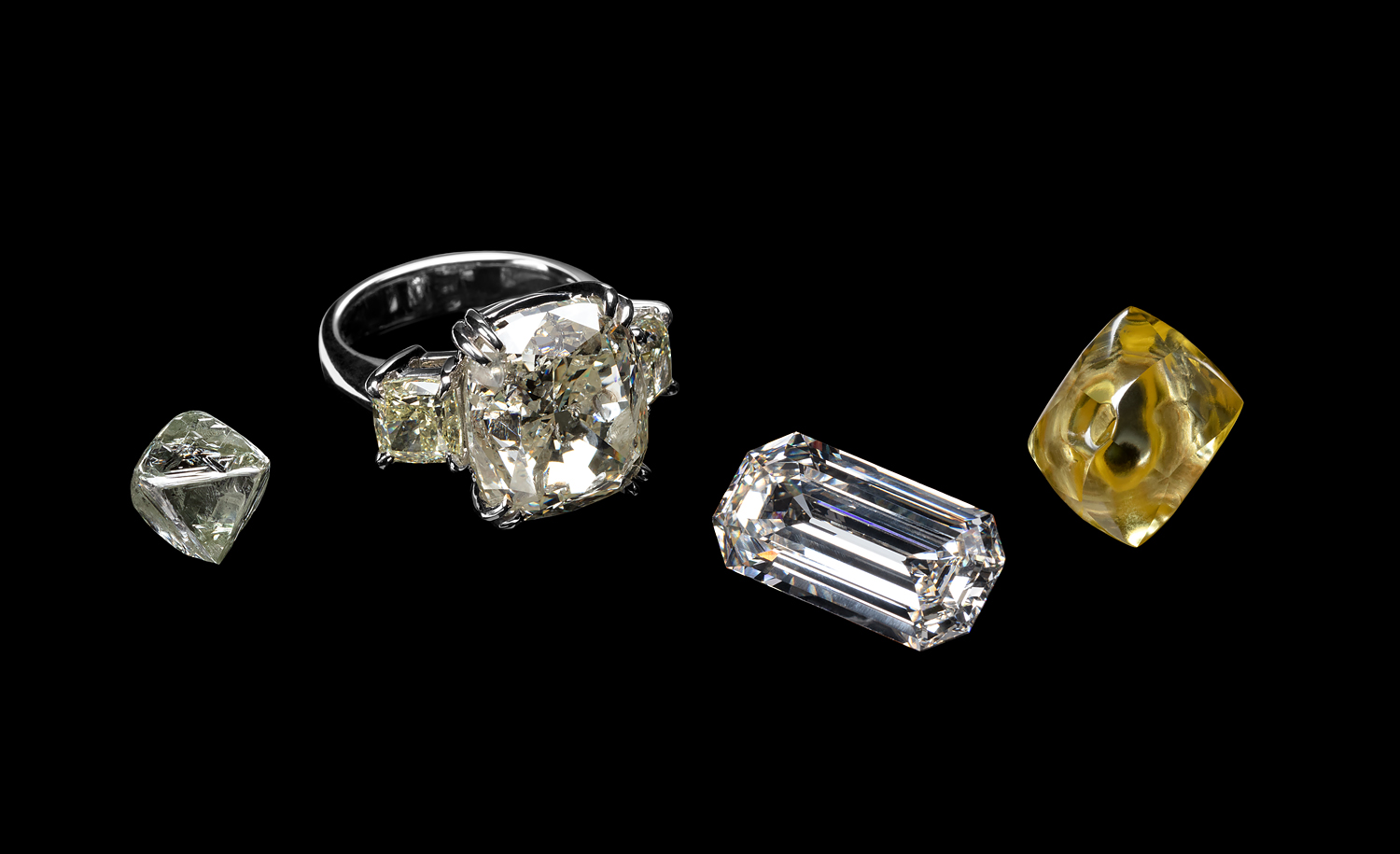
Octahedral diamond crystal — the classic kimberlite habit — Photo: Smithsonian Institution · Public domain
What is Diamond?
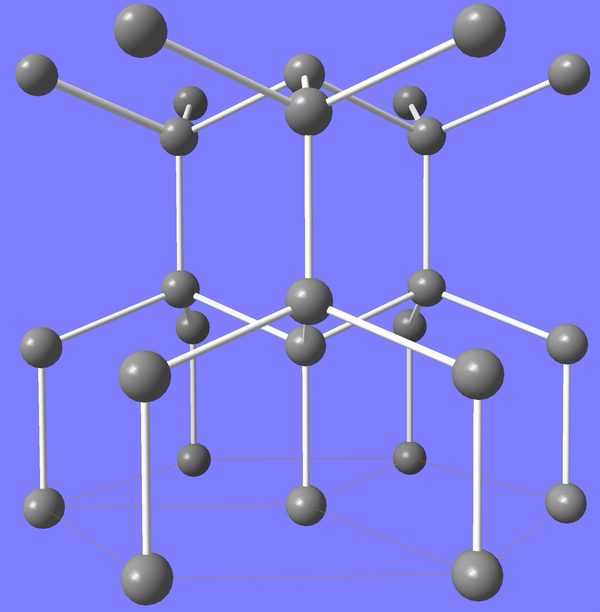
Diamond is a mineral made of a single element — carbon — bonded into the most compact structure known: every atom grips four neighbors in a tetrahedral web. That structure makes it the hardest natural material (10 on the Mohs scale), a superlative conductor of heat, and famously brilliant when cut.
Diamonds grow 150–200 km down in Earth’s mantle, under crushing pressure, and reach us only via rare, explosive kimberlite eruptions — frozen elevators from the deep Earth. Most natural diamonds are ancient, between one and three and a half billion years old.
The name comes from the Greek adamas, ‘unconquerable’. India knew diamonds in antiquity; South Africa’s 1860s–70s discoveries transformed the trade, and today Botswana, Russia, Canada and Australia lead production.
Physical Properties
The full data table is in the panel alongside. Here’s what those numbers actually mean.
Hardness. 10 on Mohs — but with a nuance: it is directional. Diamond saws exploit the hardest edges, and cutters use the octahedral cleavage to split stones cleanly.
Cleavage. Perfect on {111} in four directions — the planes that let a lapidary ‘cleave’ rough with a single strike. Hard, yes; unbreakable, no.
Brilliance and fire. A refractive index of 2.417 bends light sharply, while dispersion 0.044 splits it into spectral flashes — the combination the brilliant cut is engineered to maximize.
Fluorescence. About a third of gem diamonds glow blue under UV — nitrogen impurities at work — and a few phosphoresce after the light goes off; the Hope Diamond glows red.
Color. Pure diamond is colorless; nitrogen turns it yellow, boron turns it blue and electrically semiconducting, while radiation and lattice distortion give green, pink and the rarest reds.
How & Where It Forms
Diamond is stable only above roughly 45–50 kilobars — pressures found 150 km or deeper in the mantle, beneath ancient continental roots. There carbon crystallizes as diamond; nearer the surface the same atoms would have settled for graphite.
Kimberlite and lamproite magmas — the deepest-sourced volcanoes we know — then rip the crystals upward at highway speeds, fast enough that they never get the chance to relax into graphite. The magma freezes into carrot-shaped pipes. Erosion later frees diamonds into rivers and coastlines — the great alluvial fields — while meteorite impacts and subducted crust yield rare microdiamonds.
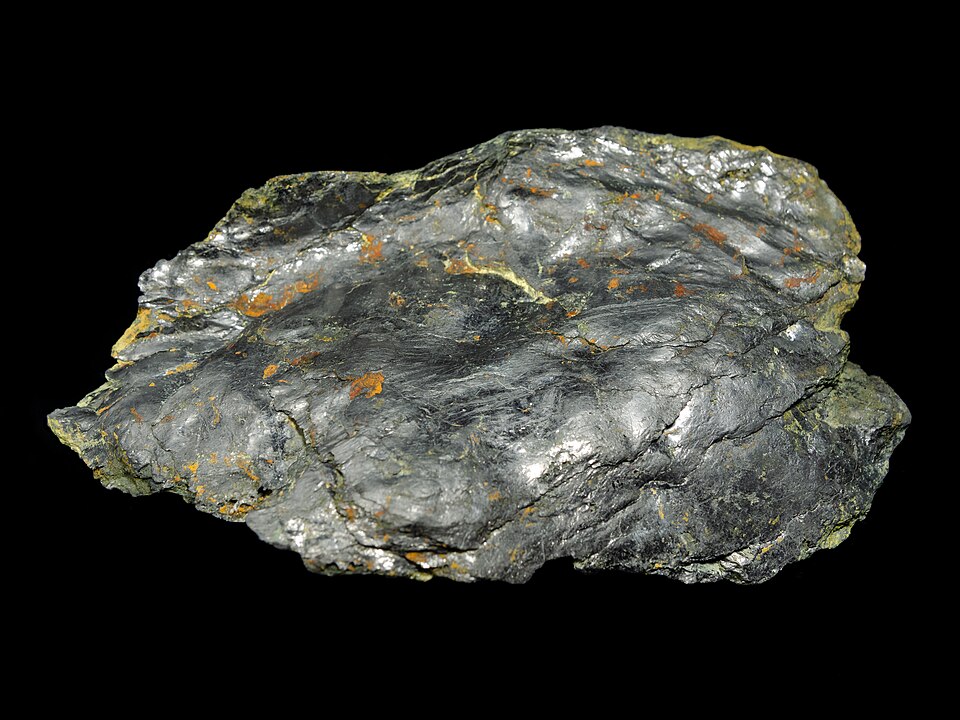
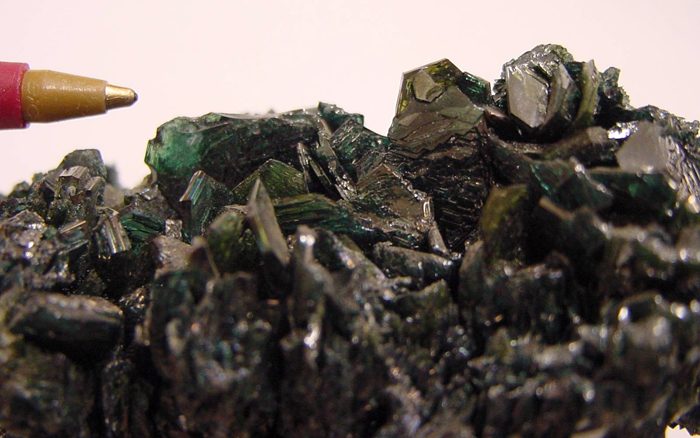
Often grows alongside:
What It’s Used For
How to Identify It
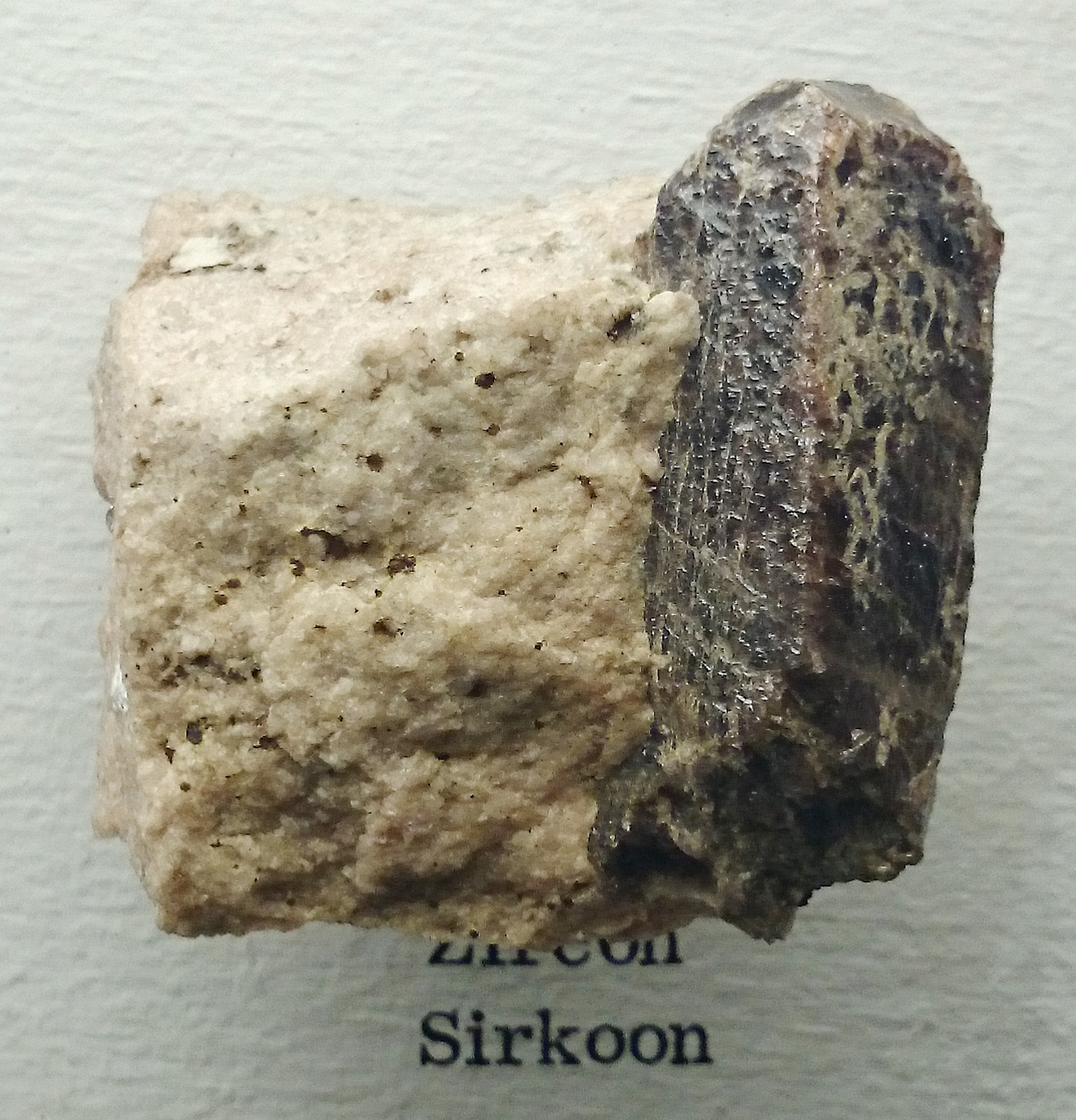
Nothing else combines hardness 10, adamantine luster and that cold, brilliant fire. Cubic zirconia is heavier and softer; moissanite shows facet doubling under a loupe; zircon doubles too and is far denser; rock crystal and glass are an instant giveaway on a refractometer (RI ~1.55 vs 2.42). The thermal-conductivity probe remains the quickest field test.
| Looks like… | But differs because… | Quick test |
|---|---|---|
| Moissanite | Doubly refractive — facet doubling under a loupe — and electrically conductive where diamond (mostly) isn’t | Loupe & probe |
| Zircon | The classic natural simulant — denser (SG ~4.7), birefringent doubling, only H 7.5 | Loupe & heft |
| Quartz | RI 1.55 vs 2.42, far less dispersion and density — ‘Herkimer diamonds’ are quartz | Refractometer |
| Topaz | The old ‘poor man’s diamond’ — softer (8) with a perfect basal cleavage and lower RI (~1.62) | Cleavage & RI |
Where It’s Found
Notable localities for fine specimens:
Gallery
Photographs from Wikimedia Commons contributors — click a credit on the main image for the source and license.
Related Minerals
Others in the same family and minerals it commonly grows alongside.
References & Further Reading
- Dana’s New Mineralogy, 8th ed. Native elements — carbon polymorphs.
- Mindat.org — Diamond mineral data and locality records.
- Wikipedia — Diamond.
Last reviewed 2026-09-14 · How to cite this page.