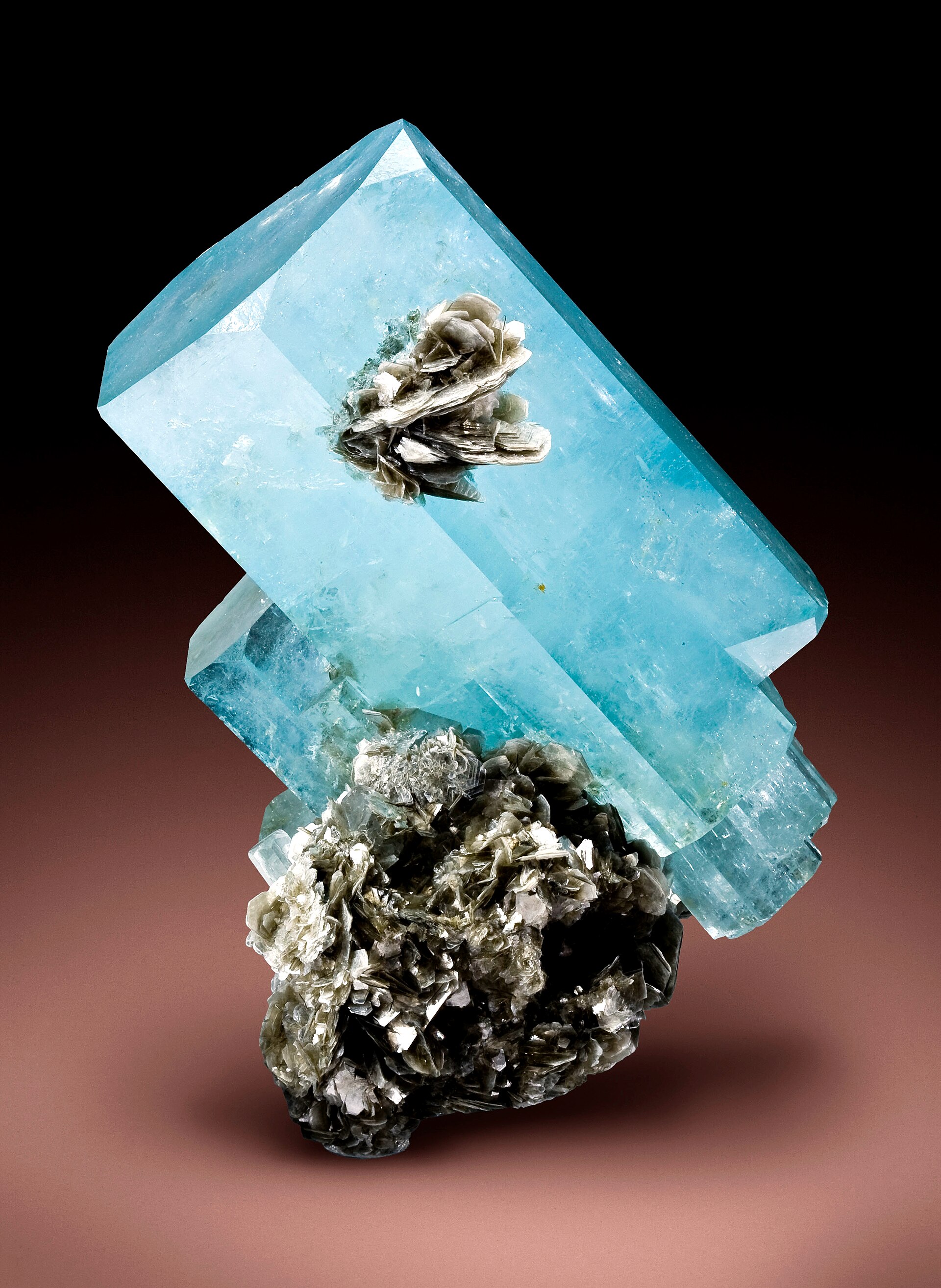
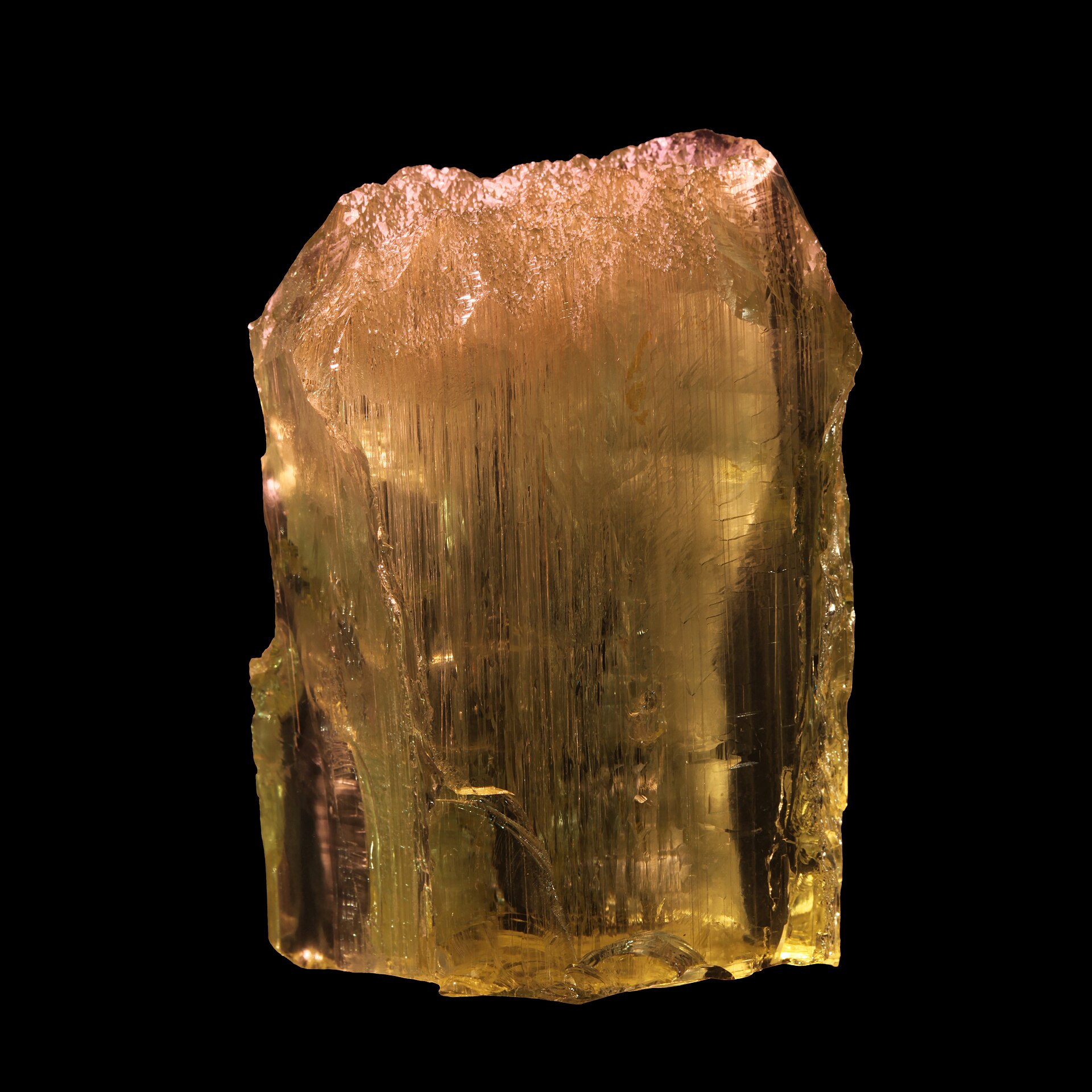
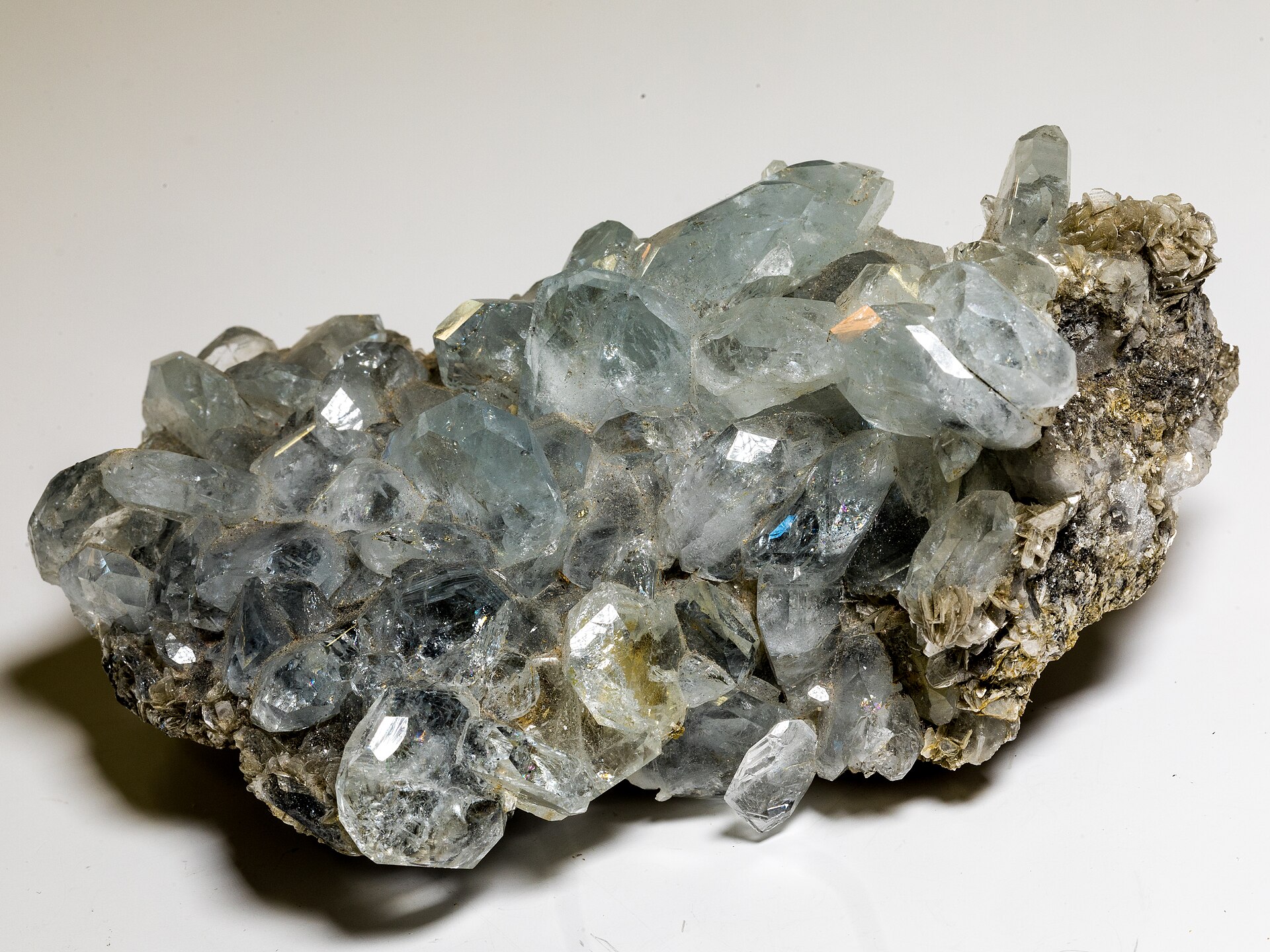
Aquamarine prisms — the sea-blue variety of beryl — Photo: Robert M. Lavinsky · CC BY-SA 3.0
What is Aquamarine?
Aquamarine is the blue to blue-green variety of beryl — the same Be₃Al₂Si₆O₁₈ mineral as emerald, colored by iron instead of chromium. Its name is literal Latin: aqua marina, ‘water of the sea’.
Where emerald is rare and included, aquamarine grows big and clean. Pegmatite pockets have yielded gem crystals weighing tens of kilograms — Brazil’s famous 1936 find was a flawless prism the size of a forearm — and faceted stones of hundreds of carats exist. It is the birthstone for March and the most popular blue gem after sapphire.
Many aquamarines began life greener than they look: a gentle heat treatment drives off the yellow component and leaves pure sea-blue.
Physical Properties
The full data table is in the panel alongside. Here’s what those numbers actually mean.
Color. Trace iron does the work: Fe²⁺ gives the blue, while Fe³⁺ adds a yellow tint that pushes the stone toward green or ‘seafoam’. Heating to about 400 °C removes the yellow — which is why most jewelry-grade aquamarine is pure blue.
Size and clarity. Unlike its sister emerald, aquamarine commonly forms large, eye-clean crystals — the gem-cutter’s dream. Inclusions, when present, are usually fine parallel hollow tubes called ‘rain’, or liquid feathers.
Optics. Uniaxial negative, refractive index ~1.57–1.59, with weak-to-distinct pleochroism: a well-oriented rough shows deeper blue down the crystal’s length, and cutters orient the table to keep it.
How & Where It Forms
Aquamarine crystallizes inside granitic pegmatites — the coarse, giant-crystal rocks that form as the last water-rich dregs of a cooling granite. Beryllium concentrates in those late fluids, and where open pockets (miaroles) exist, beryl prisms can grow to spectacular size.
Weathering then frees the crystals. Because beryl is hard and chemically stable, aquamarine also accumulates in river and alluvial gravels downstream of eroded pegmatites — Brazil’s Minas Gerais gem belt works both kinds of deposit.
Often grows alongside:
What It’s Used For
How to Identify It
The combination of hexagonal prisms, hardness 7.5–8 and pale-to-mid blue color is nearly diagnostic. Blue topaz is the commonest lookalike — it is noticeably heavier (SG ~3.5), has a higher refractive index and one perfect cleavage. Blue zircon is far denser and flashes strong doubling of facet edges under a loupe.
| Looks like… | But differs because… | Quick test |
|---|---|---|
| Topaz | Denser (SG ~3.5), higher refractive index (~1.62) and one perfect cleavage | Cleavage & SG |
| Zircon | Far denser (~4.7) with strong doubling of facet edges and adamantine luster | Heft & loupe |
| Spinel | Cubic and singly refractive; synthetic blue spinel is a common simulant | Polariscope |
| Apatite | Much softer (5) — a knife blade marks it | Hardness |
Where It’s Found
Notable localities for fine specimens:
Gallery
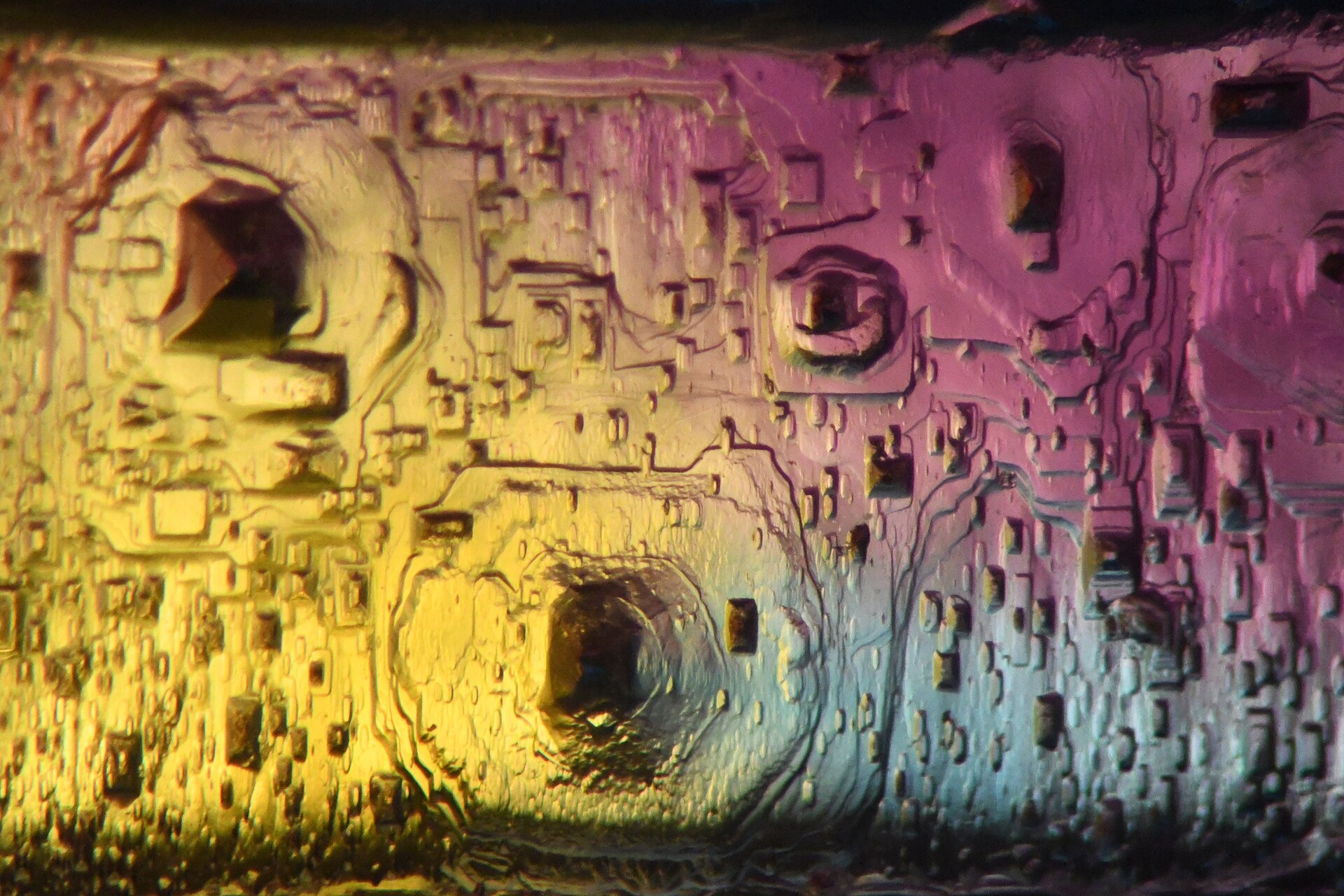
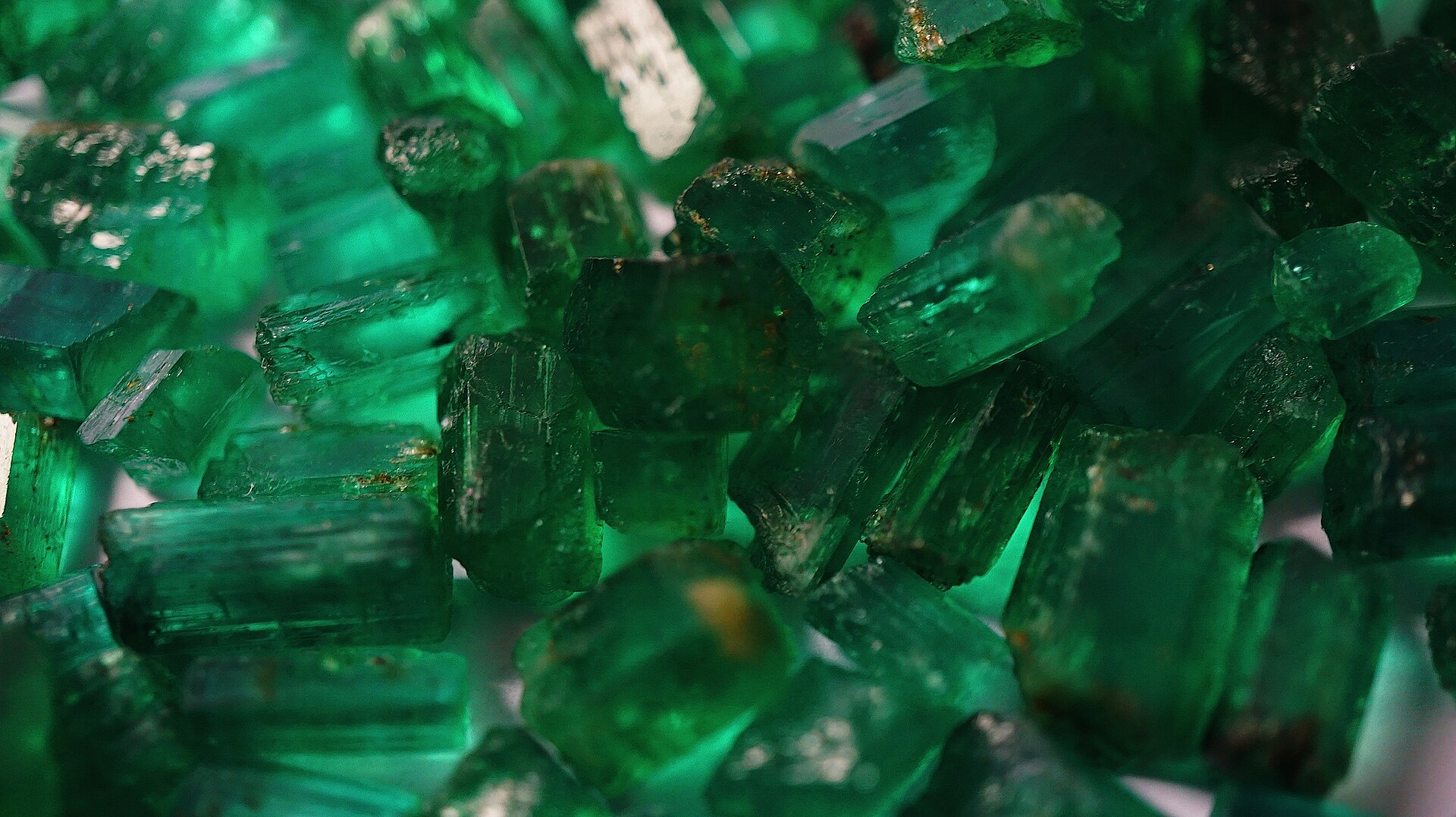
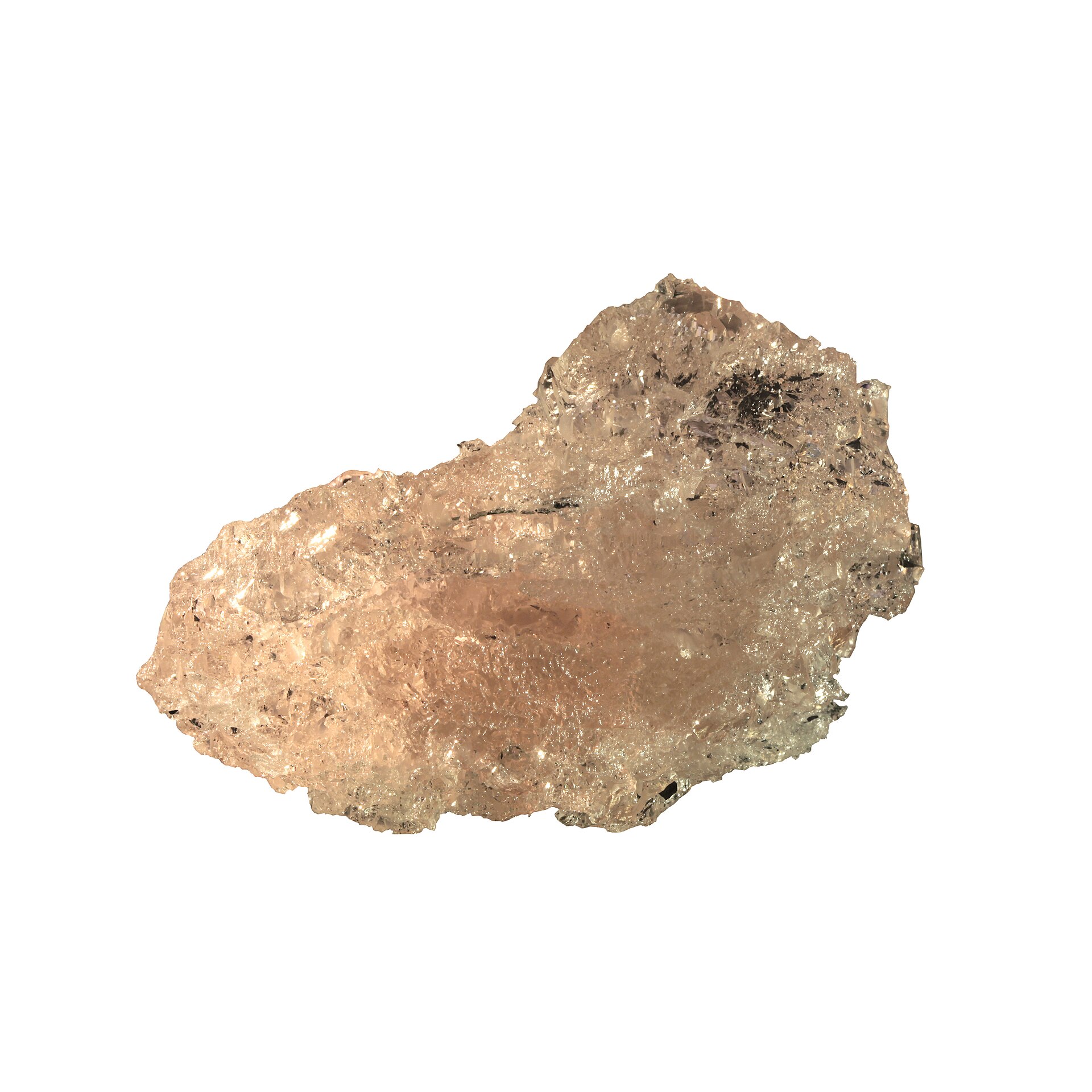
Photographs from Wikimedia Commons contributors — click a credit on the main image for the source and license.
Related Minerals
Others in the same family and minerals it commonly grows alongside.
References & Further Reading
- Dana’s New Mineralogy, 8th ed. Beryl group, cyclosilicates.
- Mindat.org — Aquamarine variety data and locality records.
- Wikipedia — Aquamarine (gem).
Last reviewed 2026-09-14 · How to cite this page.